
Camellia japonica
Well, for this GBBD it’s going down to 18 degrees tonight but this Camellia japonica doesn’t seem to mind. We have a fair number of Camellias but this particular Camellia has two parts, one which blooms early and the other half comes in the normal Spring blooming for Camellia japonicas. Here’s another view of the same plant.

Camellia japonica blooming early
Most of the other japonicas have lots of buds but no blooms as in this example.

Camellia japonica
It’s hard not to want to plant more Camellias since they have such an extensive blooming season and look good even when they are not in bloom. Here’s the last flower on the fall blooming Camellia sansanqua.

Camellia sasanqua
And then there is the very lovely little hybrid Camellia ‘Yume’ which manages to flower extensively across the late Fall to early Spring.

Camellia ‘Yume’
Other than the Camellias, flowering is still pretty limited. We are seeing the first snowdrops appearing in multiple places including the lawn.

Galanthus elwesii in the lawn
And I can now see the first flower buds on the Cyclamen Coum.

Cyclamen coum first bud
Otherwise my morning garden walk is more focused on the various ways that green contributes to the garden. Here’s the Cyclamen hederifolium for example.

Cyclamen hederifolium
I find the winter is much more tolerable when there is lots interesting greenery. Here are some other green points.

Japanese Holly Fern (Cyrtomium falcatum)

Mahonia ‘Soft Caress’

Mahonia japonica

One of many Hellebores in the woods

One of many Epimediums in the woods
I also have been tracking the Pussy Willow on the hillside as this is the first year we’ve had buds.

Pussy Willow
Of course for every winter’s day my real focus is on the Adonis and wondering when they will first show up. Here is their status.

Adonis ‘Chichibu Beni’

Adonis ‘Fukujukai’
Lastly let me note that the greenhouse has been a constant joy. Here is one of the current flowerings.

Freesia fucata
Garden Blogger’s Bloom Day September 2025

Colchicum bivonae
Well a relatively brief statement this month just to catch up for Garden Blogger’s Bloom Day. We are just returned from almost three weeks in South Africa and I can assure you that of the many flowers we saw there, Colchicum are non-existent. It’s their Springtime, not their Fall. We got home to find that Colchicum are happily flowering away (which is what to expect in mid-September).

Colchicum (of unknown variety)

Colchicum x byzantium ‘Innocence’
At the same time the usual winners for September were happily flowering despite the terrible dryness Maryland has been experiencing.

Cestrum ‘Orange Peel’
I was happy to see that the Dahlias were spreading their usual joy. Not only the Bishop in the perennial bed but also several other varieties in the vegetable garden courtesy of Swan Island Dahlias.

Dahlia ‘Bishop of Llandaff’

Dahlia from Swan Island

Dahlia from Swan Island
I’ll have to research the names when I get time. And we have a lot sunflowers and other annuals in the vegetable garden.

Annual Flowers in the Veg garden
But I do want to share that our exposure to South African Flowers was wonderful. This was all via a trip arranged by the American Horticultural Society. We’ve been a member since forever but this was our first travel experience with AHS and it was memorable. The arrangements were excellent and breadth of exposure to South African culture and plant life will stay with us for a long time. I’ll try to see if I can put together a more detailed summary at some point but here is just a glimpse of what we saw.

Candelabra aloe atop Table Mountain in Cape Town
An absolute must for Cape Town visitors is Kirstenbosch, one of the world’s outstanding Botanic Gardens. Kirstenbosch National Botanical Garden

Looking at the mountains that are part of Kirstenbosch
We happened to be there for the first annual flowering of the Crimson King Protea which was a celebration for even the curators.

Protea cyanoides (King Protea)
Driving through the countryside there were lovely vistas of wildflowers and wonderful opportunities to explore.

Dimorphotheca sinuata (African Daisy)
And although horticulture was a major interest it turned out that I spent a lot of time photographing birds which are every bit as beautiful as the plants.

Orange-breasted Sunbird on Table Mountain
Garden Blogger’s Bloom Day August 2025

Gladiolus ‘Pink Lady’
Well at this time of year for GBBD with a lot of hot humid weather the Glads are one of the flowers doing really well. They last a week in the house as the flowers open one by one.

Glads on the inside with one of the early Dahlias beside the glads
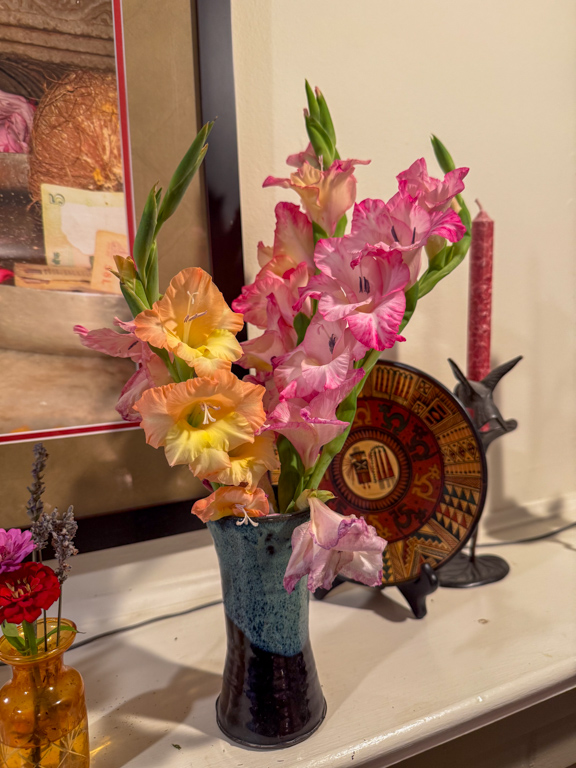
Gladious inside
Just a few days before it was time for the Surprise Lillies

Surprise Lily (Lycoris squamigera)
In the house we have the similar-flowered Rain lily relative which comes out of the greenhouse.

Habranthus robustus
The front garden bed has some very nice Butterfly Milkweed

Butterfly Milkweed (Asclepias tuberosa)
And in the back garden there is a small Crocosmia starting up.

Lucifer Crocosmia
In the back we also have a spreading installation of Mirabilis that needs to be seen at just the right time of day to appreciate the open flowers.

Four o’clock Flowers (Mirabilis jalapa)
Nearby is the Cestrum which flowers all summer long.

Cestrum ‘Orange Peel)
In the vegetable garden we have an abundant supply of annuals

Annuals galore
And on the hillside we have on of several Crepe Myrtles in flower.

Crepe Myrtle
I should also point out that for us it’s not just the flowers.

Harvesting – Veggies and Peaches

Harvesting – Peaches and Raspberries
The Contender Peach has yielded some of the best tasting peaches we’ve ever had and a good many of them are completely free of brown rot.
Lastly let me close with one shot of the berries getting ready for Fall.

Viburnum wrightii
Garden Blogger’s Bloom Day July 2025

Lilium ‘Scheherezade’
Well it’s long past the date for Garden Blogger’s Bloom Day, but I’ll explain at the end some of why I’m so late. Lillies as usual mark our summer highlights and I always wonder why I haven’t planted more. Scheherezade is really the last big one for us and it has long been a memorable part of our flower collection. It is an oriental/trumpet hybrid from the Lily Garden that can easily get up to eight feet tall. We usually bring a stalk or two into the house.
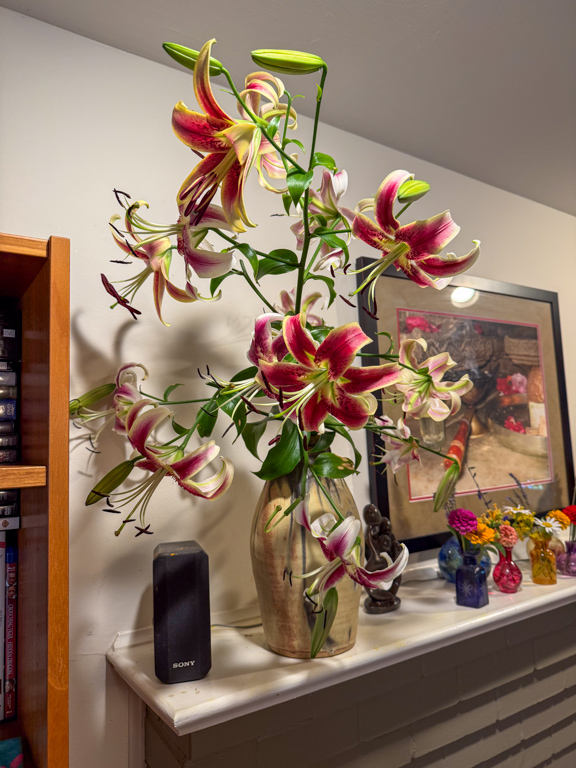
Lilium ‘Scheherezade’ on display
The other standout flower right now is the hydrangea at the back porch. This one is getting larger every year with more and more flowers.
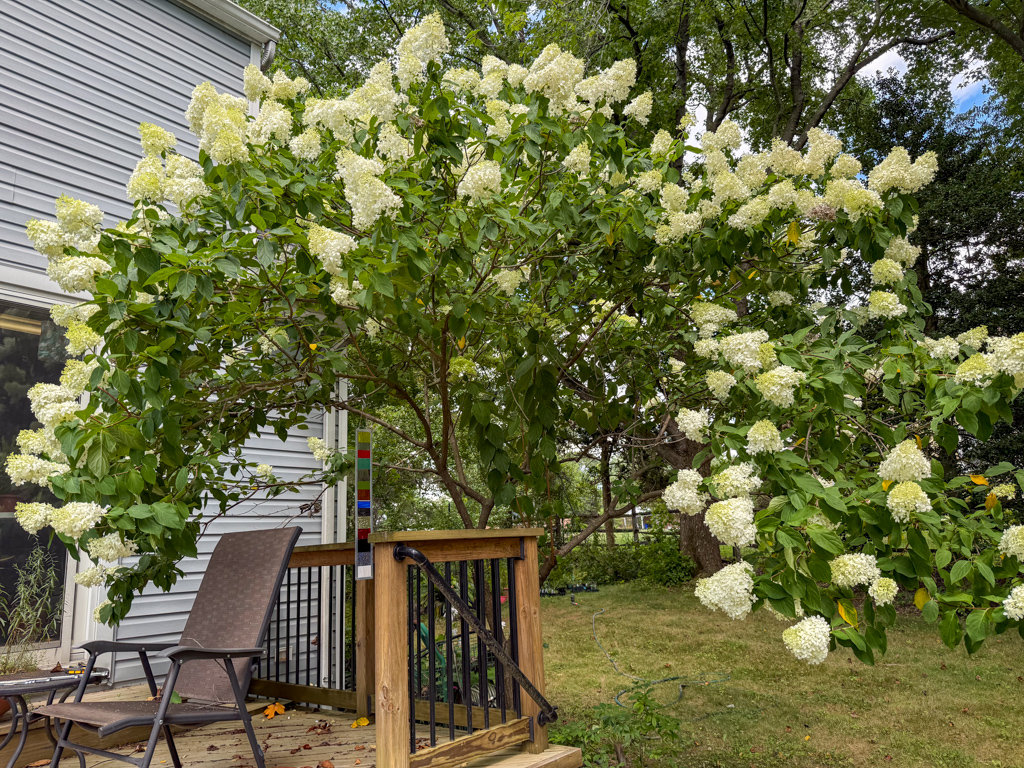
Hydrangea ‘Limelight’ in full flower
Otherwise we have the normal abundance of flowers that show up in July.

Crocus Rose

Rudbeckia dominating front bed
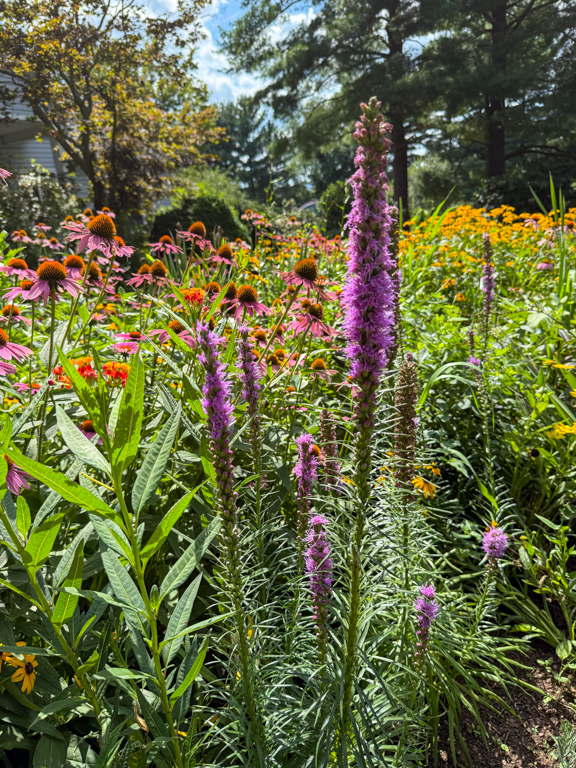
Liatris in the Front Garden

Lovely pink phox gone wild

Tithonia in the annuals bed
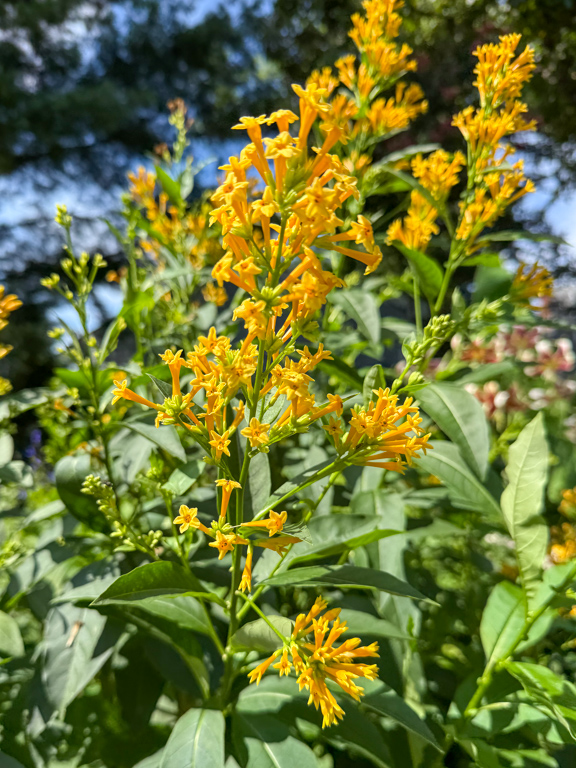
Cestrum ‘Orange Peel’ on display now

Sunflowers inside

Sunflowers welcome to the inside
I should mention that we received a particularly nice Canna from a friend and I think it will be a constant addition to our yard.

Canna ‘Cleopatra’
We also received some particularly nice new tomato cages from our son in the north
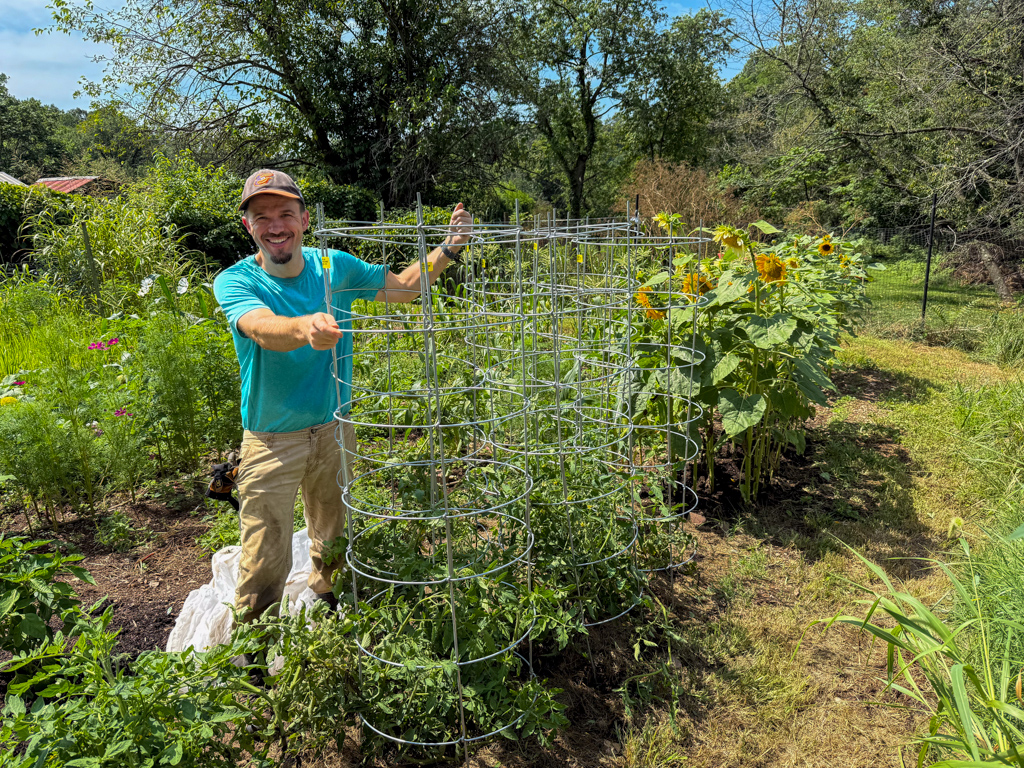
Josh holds new tomato cages
This is a marvelous product from Texas Tomato Cages that easily assembles and should last a long time.
Lastly I will share that on the normal day for posting Garden Blogger Bloom Day we found ourselves replacing part of our 60 year-old septic system. It was an adventure that hopefully we won’t have to repeat…
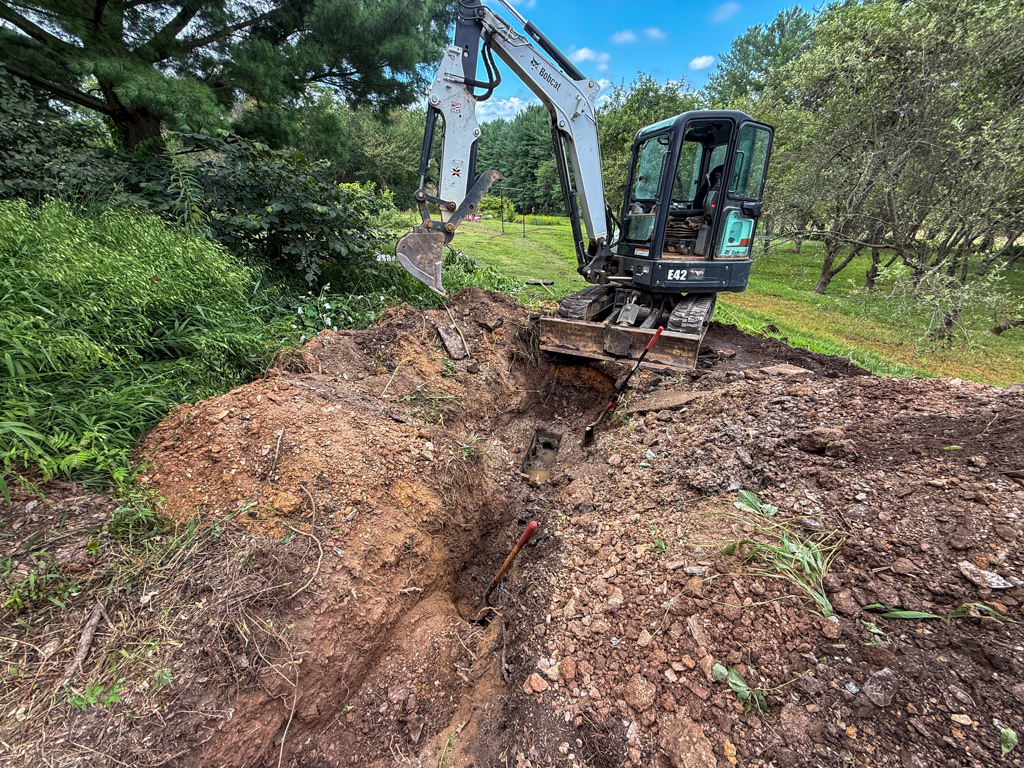
Septic solution
Garden Blogger’s Bloom Day June 2025

Bishop of Llandaff
Well it is a very late GBBD for me this month. My excuse is that I was off to Wyoming and Colorado enjoying their wildflowers. More on that if I can get myself organized. In the meantime things have been growing abundantly here in Maryland as illustrated by the Dahlia shown above. This plant has overwintered for the last six years even though it’s not really supposed to be hardy here.
Speaking of hardiness I’ve been reading that the Ismene that I grow in the greenhouse may actually survive outside here so I may split off some of the bulbs to see if that is the case. The flowers are always very striking.

Ismene x festalis
Another product of the greenhouse is the Habranthus robustus, sort of a giant rain lily.

Habranthus robustus
Meanwhile the yard is full of flowering plants right now. I can’t help but compliment the Corydalis lutea that simply blooms from Spring till Fall with lovely clover-like foliage.

Corydalis lutea
It is of course lily time. And I can share a few of those.

Lilium ‘Istanbul’

Lilium ‘Purple Marble’

Lilium ‘Pink Perfection’
The blueberries, raspberries and strawberries are just about done for local dining, but I can see we may well get some good apples this year.

Apple ‘Esopus Spitzengurg’
I can also share at least one image from the West as my excuse for being so late with this posting.

On the trail to Emerald Lake
Garden Blogger’s Bloom Day May 2025

Stewartia malacodendron
Well the garden in Maryland has gone from dry to super wet over the last month, making this GBBD as green as I can remember. But what always stand out for me at this time of year is the Stewartia Malacodendron. Also known as the Silky Camellia this is one of the most exotic tree flowers you can grow. It is fundamentally an understory plant and seems to be quite happy where it is situated now beneath our Metasequoia. I would guess there are 30-40 flowers on the tree this year.

Stewartia malacodendron
We have several other Stewartias now including a little Stewartia rostrata down in the pasture which is showing it’s first flower buds this year.

Stewartia rostrata
Another species added to the pasture arboretum this year is a Magnolia.

Magnolia figo ‘Serendipity’
This was from Hazelmor nursery at the Stonecrop annual Alpine sales event.
While mentioning our nice trees I should cite the Frisia Locust which is beginning to show the lovely yellow-green leaves that make it different than other locusts.

‘Frisia’ Black Locust
We first saw this at the entrance to Chanticleer Gardens near Philadelphia.
And while I’m on trees I should note that the Chinese Dogwood in our backyard is fully in flower at the moment.

Chinese Dogwood (Cornus kousa)
You would have to climb on the roof to fully appreciate the hundreds of flowers on this tree. And if you were to do that you would see even more flowers on the 50 foot tall Tulip Poplar which dominates our backyard. I am surprised that everyone doesn’t have a Tulip Poplar to litter their yard with flower petals.
Speaking of flower petals I should note that the Pink Evening Primrose, that accidentally ended up in our pasture, has continued to spread across the hillside with it’s lovely flowers.

Pink Evening Primrose (Oenothera specioosa) on the hillside

Pink Evening Primrose (Oenothera specioosa)
A few other items of note. Last year I added a Mountain Laurel to the forest and it continues to do well.

Kalmia latifolia ‘Minuet’
So I’ve added 2 more…
And back in the forest I also put in a a Carolina Allspice last year.

Carolina allspice (Calycanthus floridus)
And the flowers are gorgeous.

Carolina Allspice flower
Just a few more things to note…
The True Indigo by the back garden gate is very nice.

True Indigo (Indigofera tinctoria)
And the red Bletilla is quite striking again this year.

Bletilla striata
Two Azaleas are reminders that Rhododendrons can dominate the landscape in May.

Azalea ‘Visco sepala’

Rhododendron ‘Klondyke’
Lastly it is good to remember that one needs to eat something besides flowers. We finally got the vegetable bed plant in time for all the rain we’ve been having.

Laying out the garden
Garden Blogger’s Bloom Day April 2025

Paeonia dahurica
Well this is the magic time of year for a Garden Blogger Bloom Day Post. It seems everything is in flower or in bud. The peony shown above is actually the second to bloom. The first for us is always Paeonia caucasica.

Paeonia caucasica
In addition to sharing some of the abundant flowering happening right now I wanted to share the Open Garden Day which we held last weekend. We had a lot of visitors who asked many questions and made me focus on what I do and don’t remember about some of the plants we have put in.
The Viburnum which is providing amazing scent to the backyard (for those who still have the ability to smell which is not me) is either Viburnum carlesii or a relative bred from V. carlesii called Viburnum carcephalum and as near I can tell I’ve used both names to describe this wonderful plant.

Viburnum calesii or carcephalum?
In the backyard is a wonderful little spreader called Hacquetia epipactis.

Haquetia epipactis
And I was incorrectly describing it as Hylomecon which is another part of the yard and just coming into flower.

Hylomecon japonica
A number of people were asking about the Epimediums and I inevitably focus on the fifteen year-old plants which came to us as Mother’s day gifts from our kids.

Epimedium grandiflorum ‘Lilac Seedling’

Epimedium x rubrum ‘Sweetheart’
But there are a great many other Epimediums around the property that we got from Garden Vision Epimediums until Karen Perkins closed up shop three years ago.

Epimedium grandiflorum ‘Bicolor Giant’

Epimedium wushanense ‘Sandy Claws’
Notice the new leaves are red and the old ones green. There are many Epimediums in the woods as well because it turns out that many are four season plants with little need for regular care.
Also in the woods is a bamboo (Fargesia rufa) that survives with little care or tending.

Bamboo (Fargesia rufa)
Of course the obvious thing in the woods at this time of year is Virginia Bluebells.

Virginia Bluebells (Mertensia virginiana)
And we have a great many daffodil varieties that can be enjoyed.

Narcisus ‘Badgeworth’

Narcissus ‘A Million Kisses’

Narcissus ‘Arguros’
Also in the woods are a few special flowers that have managed to take hold.

Erythronium ‘Pacific Sunset’

Sanguinaria multiplex
Back in the yard we have a small phlox that is always an early charmer.

Phlox sileniflora
And I added a very nice little Anemonella to a trough last year.

Anemonella thalictroides ‘Kikuzaki White’ (from Japan Engei Nursery)
In the same trough is a lovely Pulsatilla from Edelweiss that has been blooming for about a month now.

Pulsatilla ambigua
One item that received attention was the Golden Pea and I realized I should look at moving more of these into the forest where it should spread easily.

Golden Pea (Lathryrus aureus)
Let me close with this Geranium maderense which I’m hoping will yield flowers this year to match the spectacular foliage. It takes two years to get the point of flowering and I’m considering putting it into the ground now that it’s made it over the winter in the greenhouse.

Geranium maderense
And So We Begin (April 2025)

Adonis amurensis ‘Pleniflora’
“The world is changed. I feel it in the water. I feel it in the earth. I smell it in the air. ” — The Lord of the Rings
The world is full of flowers right now and I am compelled to share what I see. The Adonis shown above is very tiny and it is one of many exquisite little flowers worthy of our attention right now.
I used to grow the Chilean Blue Crocus many years ago and have been trying regrow it for sometime. Finally it has returned to Ball Rd. courtesy of Telos Rare Bulbs.

Tecophilaea cyanocrocus var. leichtlinii
Nearby we have another unusual visitor, this time from Illahe Rare Plants. I have been trying to grow a yellow Fritillaria for years.

Fritillaria pudica
Nearby are the Jeffersonia which are expanding their clumps every year.

Jeffersonia dubia
Bloodroots are also coming into bloom right now and they are happy in the yard and woods.

Sanguinaria canadensis ‘Tennessee Form’
Nearby is a very rare Podophyllum just starting up.

Podophyllum x inexpectatum
Also in the yard we have an exceptionally nice Erythronium which reminds me of hiking in the Cascades.

Erythronium grandiflorum
Of course for us the really plentiful flowers at the beginning of April are the Erythronium americanum.

Erythronium americanum
They are so thick in the raised bed around our back porch that I couldn’t resist putting them in the woods as well. That was probably 20 years ago and while they have prospered in the woods, spreading like mad, they didn’t flower like they do in the raised bed. One thesis I’ve read about this said that they are happy to spread by runners if there are no constraints so they don’t bother with this flowering nonsense. Nonetheless we did get a flower two years ago and this year we are actually up to 6 flowers in the woods so there may be many more in the future.

Erythronium americanum in the woods
Also in the woods we have a great many Corydalis in flower at the moment, mostly ‘Beth Evans’ and ‘Purple Rain’.

Corydalis ‘Purple Rain’
We also have a large number of Ranunculus ficaria spreading in the woods.

Ranunculus ficaria ‘Randall’s White’
Of course the woods are full of Virginia Bluebells right now.

Mertensia virginica
And yesterday I saw the first Spring Beauty at the bottom of the woods.

Spring Beauty (Claytonia Virginica)
We would be remiss if I didn’t note that Daffodils are everywhere. This is their time of the year.

Daffodils on the hillside

Daffodils on the pasture trail

Narcissus ‘Chromacolor’ (this is one of my favorites)

Narcissus ‘Bridal Crown’
I should mention that the first of the Rhododendrons is now in bloom.

Rhododendron carolinianum
And just to prepare for the future we have the first leaves of a spectacular red-leaved maple coming out…

Acer palmatum ‘Shin Deshojo’