
Colchicum bivonae
Well a relatively brief statement this month just to catch up for Garden Blogger’s Bloom Day. We are just returned from almost three weeks in South Africa and I can assure you that of the many flowers we saw there, Colchicum are non-existent. It’s their Springtime, not their Fall. We got home to find that Colchicum are happily flowering away (which is what to expect in mid-September).

Colchicum (of unknown variety)

Colchicum x byzantium ‘Innocence’
At the same time the usual winners for September were happily flowering despite the terrible dryness Maryland has been experiencing.

Cestrum ‘Orange Peel’
I was happy to see that the Dahlias were spreading their usual joy. Not only the Bishop in the perennial bed but also several other varieties in the vegetable garden courtesy of Swan Island Dahlias.

Dahlia ‘Bishop of Llandaff’

Dahlia from Swan Island

Dahlia from Swan Island
I’ll have to research the names when I get time. And we have a lot sunflowers and other annuals in the vegetable garden.

Annual Flowers in the Veg garden
But I do want to share that our exposure to South African Flowers was wonderful. This was all via a trip arranged by the American Horticultural Society. We’ve been a member since forever but this was our first travel experience with AHS and it was memorable. The arrangements were excellent and breadth of exposure to South African culture and plant life will stay with us for a long time. I’ll try to see if I can put together a more detailed summary at some point but here is just a glimpse of what we saw.

Candelabra aloe atop Table Mountain in Cape Town
An absolute must for Cape Town visitors is Kirstenbosch, one of the world’s outstanding Botanic Gardens. Kirstenbosch National Botanical Garden

Looking at the mountains that are part of Kirstenbosch
We happened to be there for the first annual flowering of the Crimson King Protea which was a celebration for even the curators.

Protea cyanoides (King Protea)
Driving through the countryside there were lovely vistas of wildflowers and wonderful opportunities to explore.

Dimorphotheca sinuata (African Daisy)
And although horticulture was a major interest it turned out that I spent a lot of time photographing birds which are every bit as beautiful as the plants.

Orange-breasted Sunbird on Table Mountain
Garden Blogger’s Bloom Day July 2025

Lilium ‘Scheherezade’
Well it’s long past the date for Garden Blogger’s Bloom Day, but I’ll explain at the end some of why I’m so late. Lillies as usual mark our summer highlights and I always wonder why I haven’t planted more. Scheherezade is really the last big one for us and it has long been a memorable part of our flower collection. It is an oriental/trumpet hybrid from the Lily Garden that can easily get up to eight feet tall. We usually bring a stalk or two into the house.
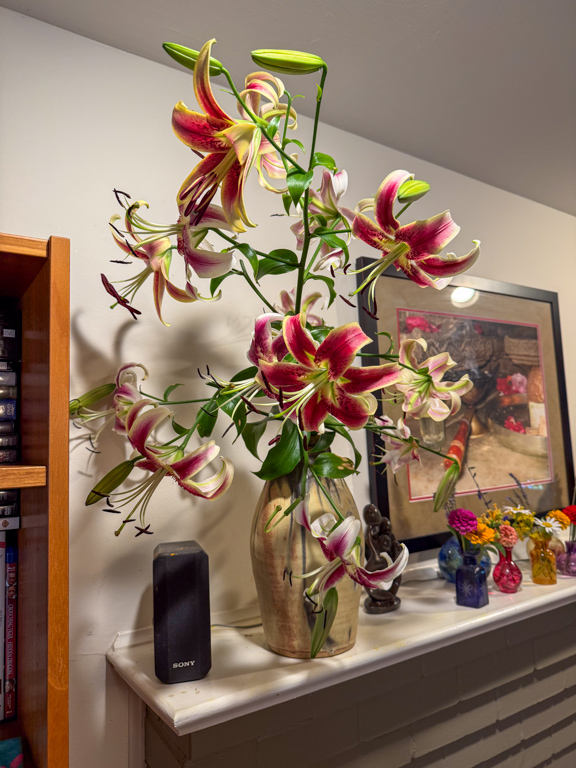
Lilium ‘Scheherezade’ on display
The other standout flower right now is the hydrangea at the back porch. This one is getting larger every year with more and more flowers.
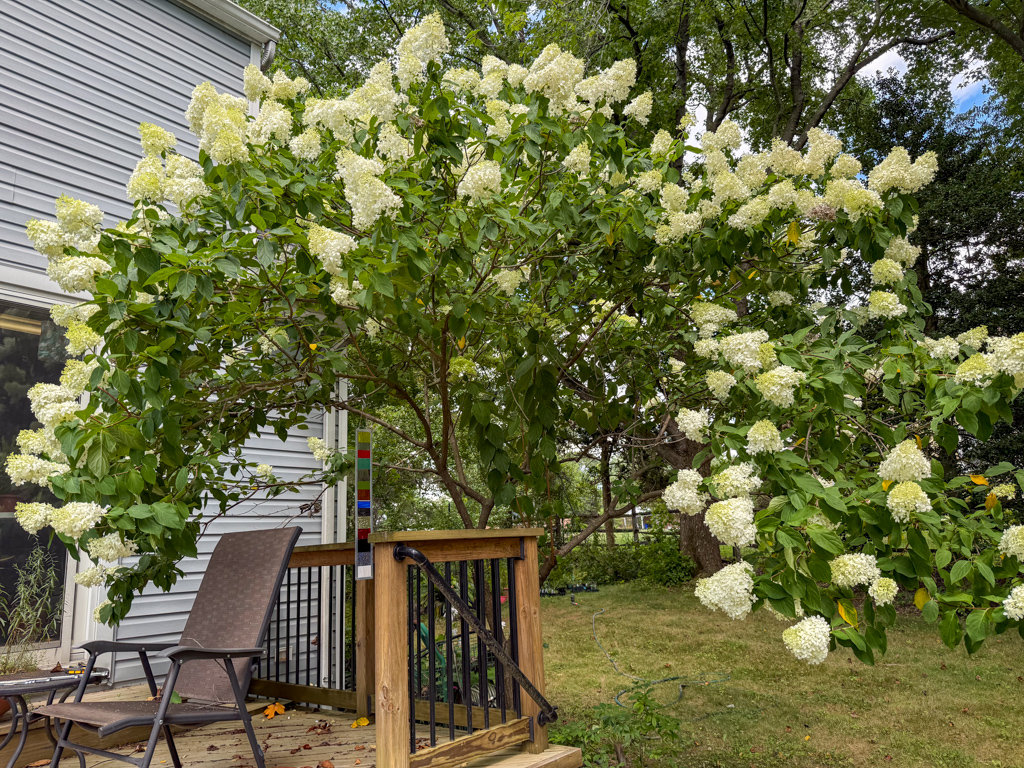
Hydrangea ‘Limelight’ in full flower
Otherwise we have the normal abundance of flowers that show up in July.

Crocus Rose

Rudbeckia dominating front bed
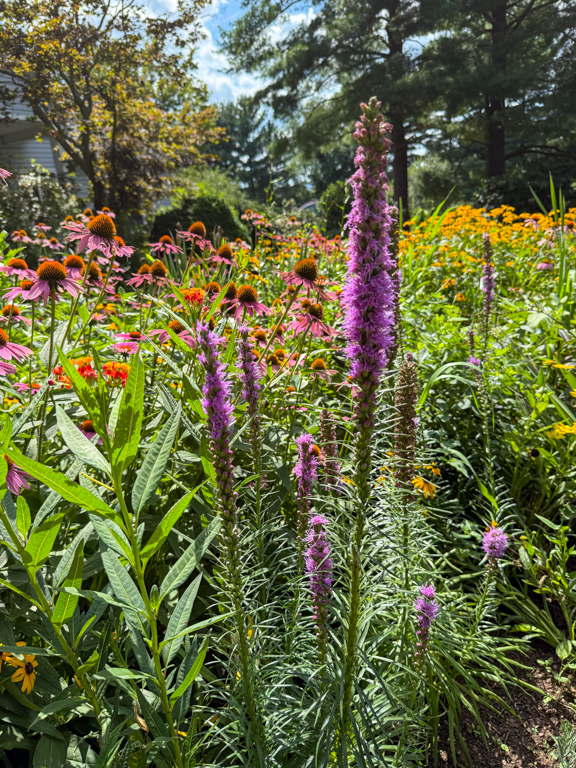
Liatris in the Front Garden

Lovely pink phox gone wild

Tithonia in the annuals bed
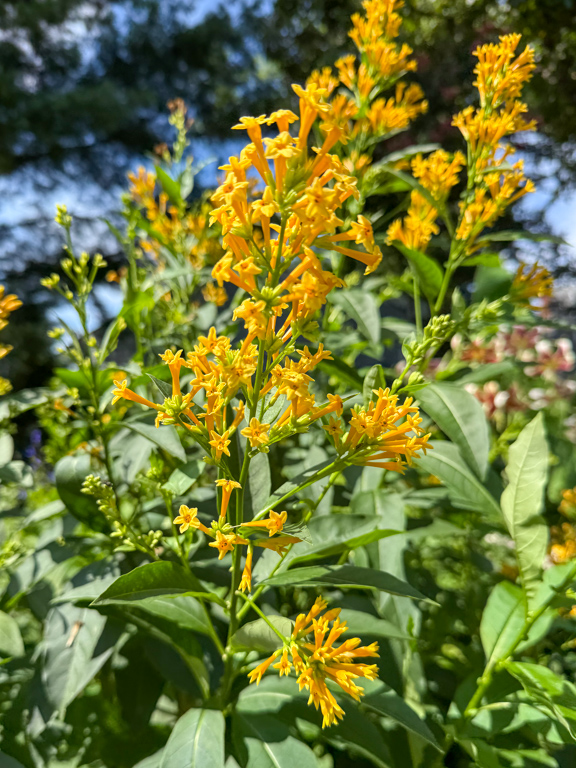
Cestrum ‘Orange Peel’ on display now

Sunflowers inside

Sunflowers welcome to the inside
I should mention that we received a particularly nice Canna from a friend and I think it will be a constant addition to our yard.

Canna ‘Cleopatra’
We also received some particularly nice new tomato cages from our son in the north
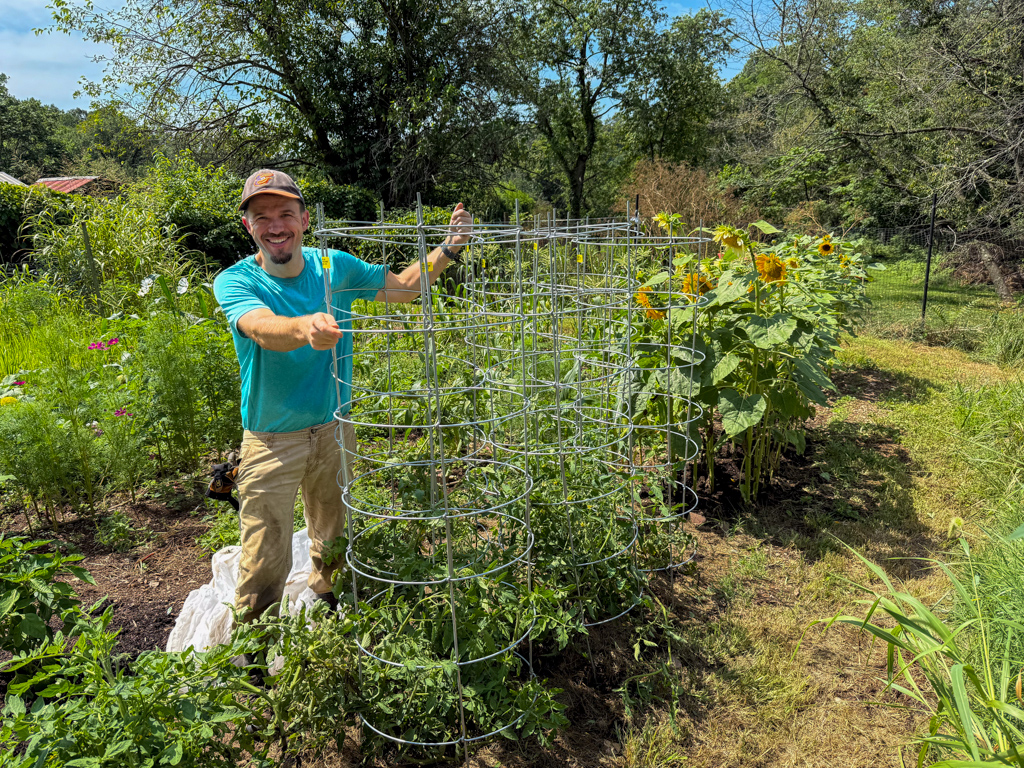
Josh holds new tomato cages
This is a marvelous product from Texas Tomato Cages that easily assembles and should last a long time.
Lastly I will share that on the normal day for posting Garden Blogger Bloom Day we found ourselves replacing part of our 60 year-old septic system. It was an adventure that hopefully we won’t have to repeat…
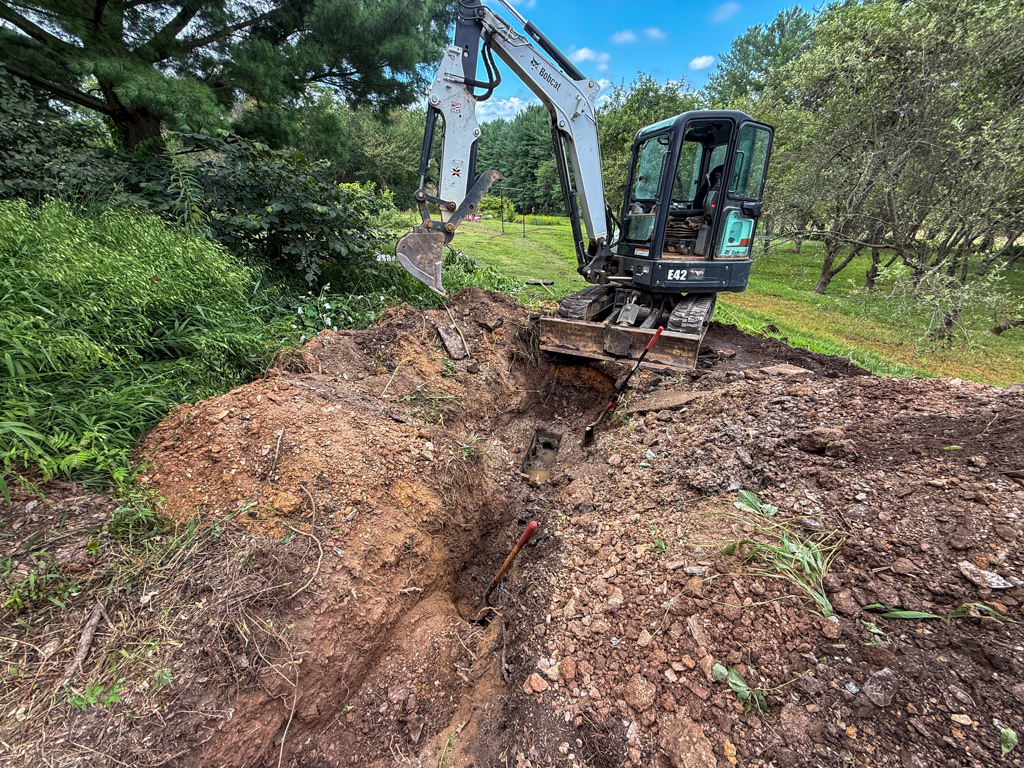
Septic solution
And So We Begin (April 2025)

Adonis amurensis ‘Pleniflora’
“The world is changed. I feel it in the water. I feel it in the earth. I smell it in the air. ” — The Lord of the Rings
The world is full of flowers right now and I am compelled to share what I see. The Adonis shown above is very tiny and it is one of many exquisite little flowers worthy of our attention right now.
I used to grow the Chilean Blue Crocus many years ago and have been trying regrow it for sometime. Finally it has returned to Ball Rd. courtesy of Telos Rare Bulbs.

Tecophilaea cyanocrocus var. leichtlinii
Nearby we have another unusual visitor, this time from Illahe Rare Plants. I have been trying to grow a yellow Fritillaria for years.

Fritillaria pudica
Nearby are the Jeffersonia which are expanding their clumps every year.

Jeffersonia dubia
Bloodroots are also coming into bloom right now and they are happy in the yard and woods.

Sanguinaria canadensis ‘Tennessee Form’
Nearby is a very rare Podophyllum just starting up.

Podophyllum x inexpectatum
Also in the yard we have an exceptionally nice Erythronium which reminds me of hiking in the Cascades.

Erythronium grandiflorum
Of course for us the really plentiful flowers at the beginning of April are the Erythronium americanum.

Erythronium americanum
They are so thick in the raised bed around our back porch that I couldn’t resist putting them in the woods as well. That was probably 20 years ago and while they have prospered in the woods, spreading like mad, they didn’t flower like they do in the raised bed. One thesis I’ve read about this said that they are happy to spread by runners if there are no constraints so they don’t bother with this flowering nonsense. Nonetheless we did get a flower two years ago and this year we are actually up to 6 flowers in the woods so there may be many more in the future.

Erythronium americanum in the woods
Also in the woods we have a great many Corydalis in flower at the moment, mostly ‘Beth Evans’ and ‘Purple Rain’.

Corydalis ‘Purple Rain’
We also have a large number of Ranunculus ficaria spreading in the woods.

Ranunculus ficaria ‘Randall’s White’
Of course the woods are full of Virginia Bluebells right now.

Mertensia virginica
And yesterday I saw the first Spring Beauty at the bottom of the woods.

Spring Beauty (Claytonia Virginica)
We would be remiss if I didn’t note that Daffodils are everywhere. This is their time of the year.

Daffodils on the hillside

Daffodils on the pasture trail

Narcissus ‘Chromacolor’ (this is one of my favorites)

Narcissus ‘Bridal Crown’
I should mention that the first of the Rhododendrons is now in bloom.

Rhododendron carolinianum
And just to prepare for the future we have the first leaves of a spectacular red-leaved maple coming out…

Acer palmatum ‘Shin Deshojo’
Garden Blogger’s Bloom Day February 2025

Adonis Fukujukai
Well, it’s Garden Blogger’s Bloom Day again and while there are many more blooms than we had last month it’s clear that winter is still with us. We spent most of the last month enjoying the warmth of California and returned home to find many of the bulbs trying their best to get started despite the distinctly unusual cold weather this year.
As always at this time of year, it is the Adonis that offer a sparkling bright yellow invitation to Spring. I’ve noticed that although we have several varieties of Adonis it is always the Adonis Fukujukai that leads the way.

Adonis Fukujukai Clump
Unfortunately all sources of this plant have dried up or disappeared so I’m thinking about splitting off a piece of this clump to make sure it spreads further. It’s a sterile hybrid so I suspect that’s why it’s hard to come by. There is a very good writeup on BotanyCa that explains why it’s so hard to obtain Adonis.
Another early starter is Crocus Korolkowii

Crocus korolkowii ‘Lemon Tiger’
This one is way ahead of our other Crocus with a bright yellow that catches the eye.
Another yellow for this time of year is Winter Aconite.

Winter Aconite (Eranthis hyemalis)
We have a number of these scattered in the woods. Not only are they super hardy, but they increase in number every year. I assume that insects contribute to the spreading of the flowers because I’ve found them in places where I know I did not plant them.
Of course another early yellow is the Witch Hazel.

Witch Hazel coming into bloom

Witch Hazel (Hamamelis mollis) first straps showing
We have several Witch Hazels but this is always the first one to greet the Spring.
And when we are talking about yellow we have to share the first Daffodil of Spring.

Rinjveld’s Early Sensation
For early flowers there are also the snowdrops.

Volunteer Galanthus elwesii in the grass
The remarkable thing I’ve noted the last couple of years is that this particular snowdrop is happily spreading into the grass.
Along the front fence I see the Edgeworthia plumping up.

Edgeworthia
I almost think they are prettier before they actually flower.
On the side of the hill I see the first evidence of Colchicum getting ready for a burst of green leaves.

Colchicum
In the greenhouse I spied a single flower from a high alpine buttercup that was planted last year.

Ranunculus caliandrinoides
And I’ve moved into the house a pot of hybrid Cyrtanthus that is particularly showy.

Hybrid Cyrtanthus
Garden Blogger’s Bloom Day January 2024
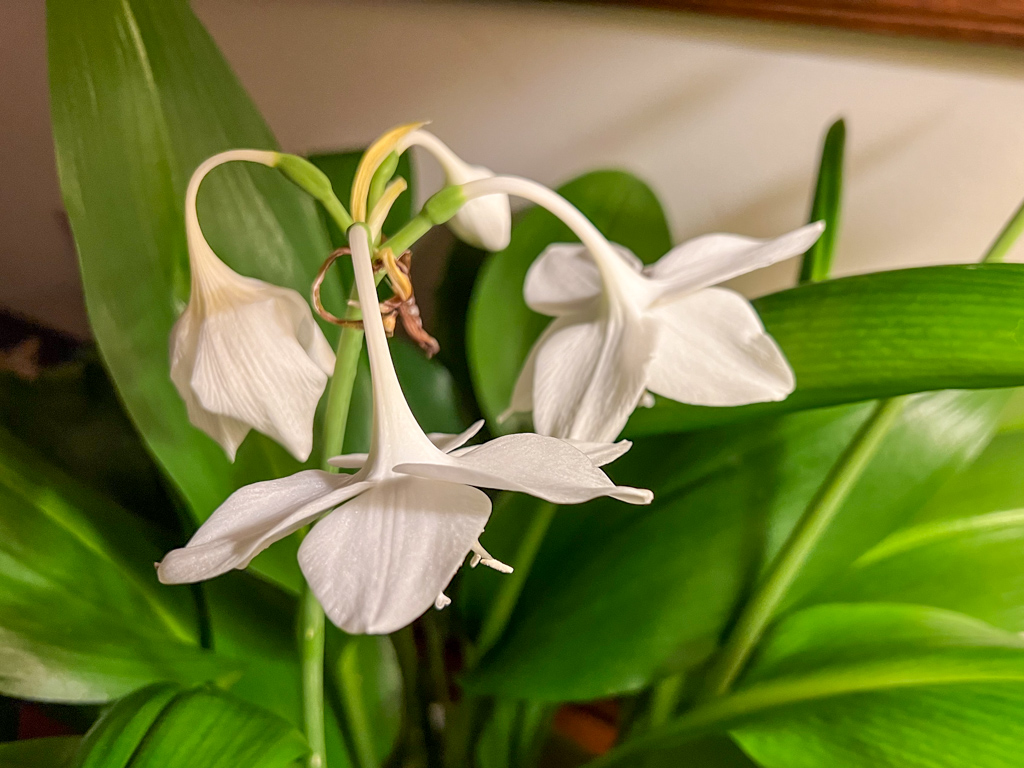
Amazon Lily
Well it’s getting cold for this Garden Blogger’s Bloom Day. Coldest temps of the winter expected this week. So I thought I would start with the Amazon Lily pictured above. This plant is about 30 years old and has never been repotted. It flowers twice a year with these orchid like flowers and survives with minimal care. We put it outside once the frost has passed us by and it will flower again in July. Highly recommended.
On the outside of the house right now the camellias are still the special flowers. This one sits in the northeast corner of the house and survives even being outside the deer fence.
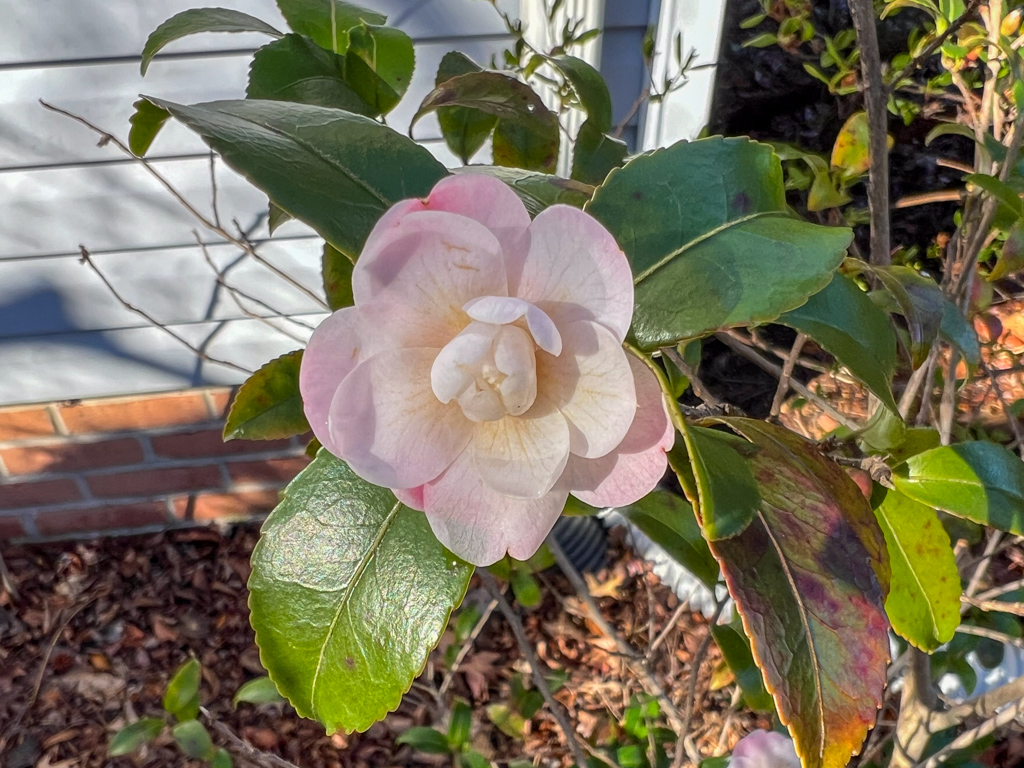
Camellia Sasanqua October Magic Orchid
Another special camellia is ‘Yume’ which has become pretty reliable.
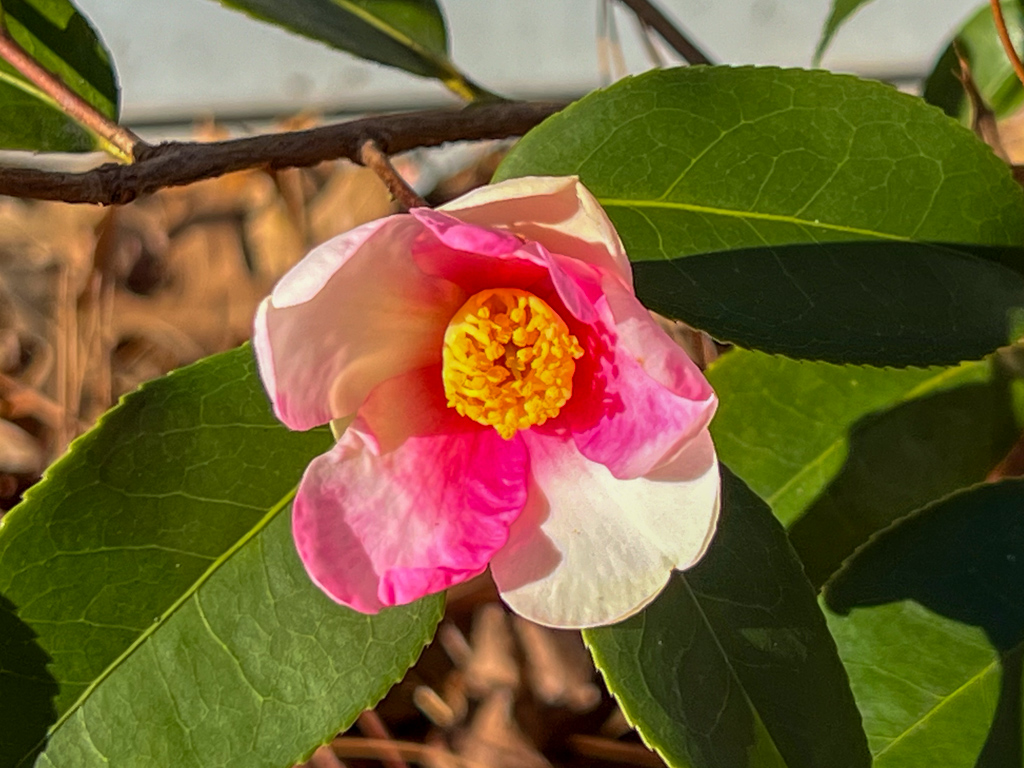
Camellia ‘Yume’
Of course if you stopped by for a visit right now I would take you out to see the first daffodils. Rinjveld’s Early Sensation may turn out to be too early as the flowers may get blasted this week.
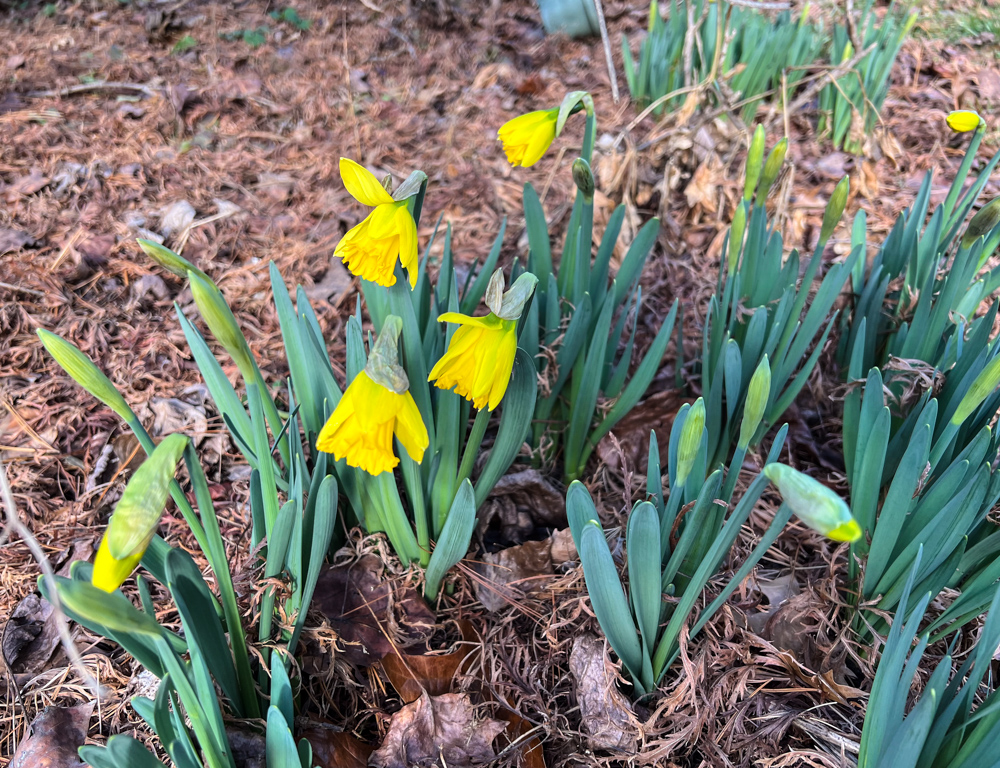
Daffodil ‘Rinjveld’s Early Sensation’
Otherwise what we have are a number of snowdrops, one of which has seeded itself into the lawn.
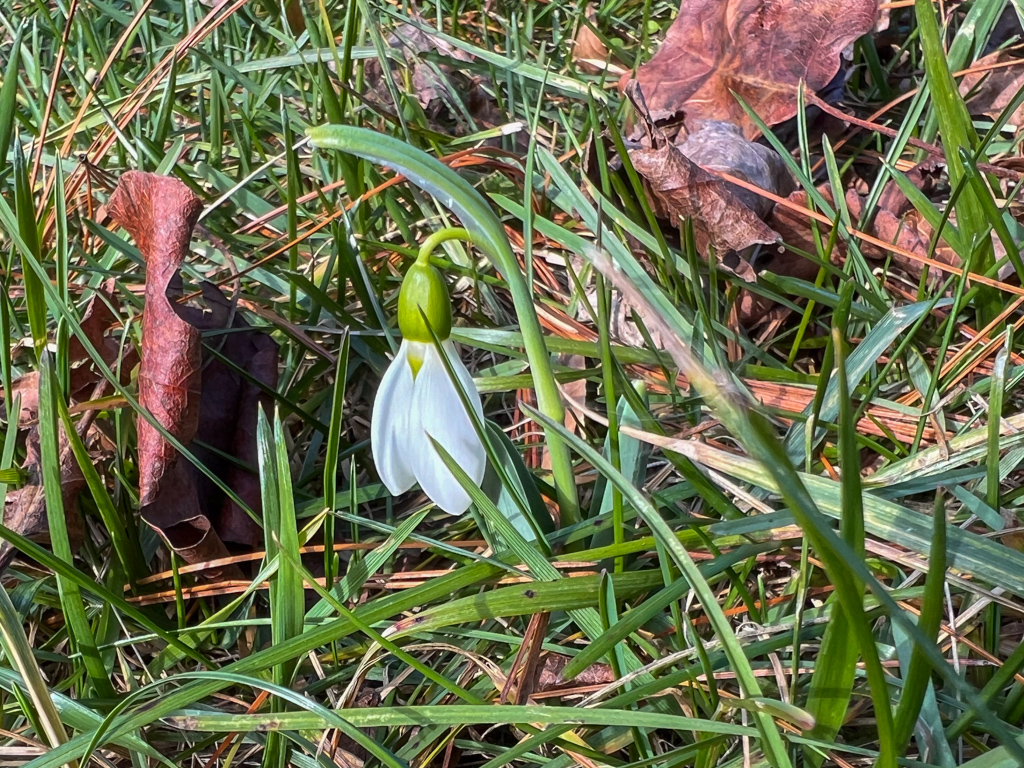
Galanthus elwesii
Out in the woods we do have a distinctive foetidus hellebore coming into flower.
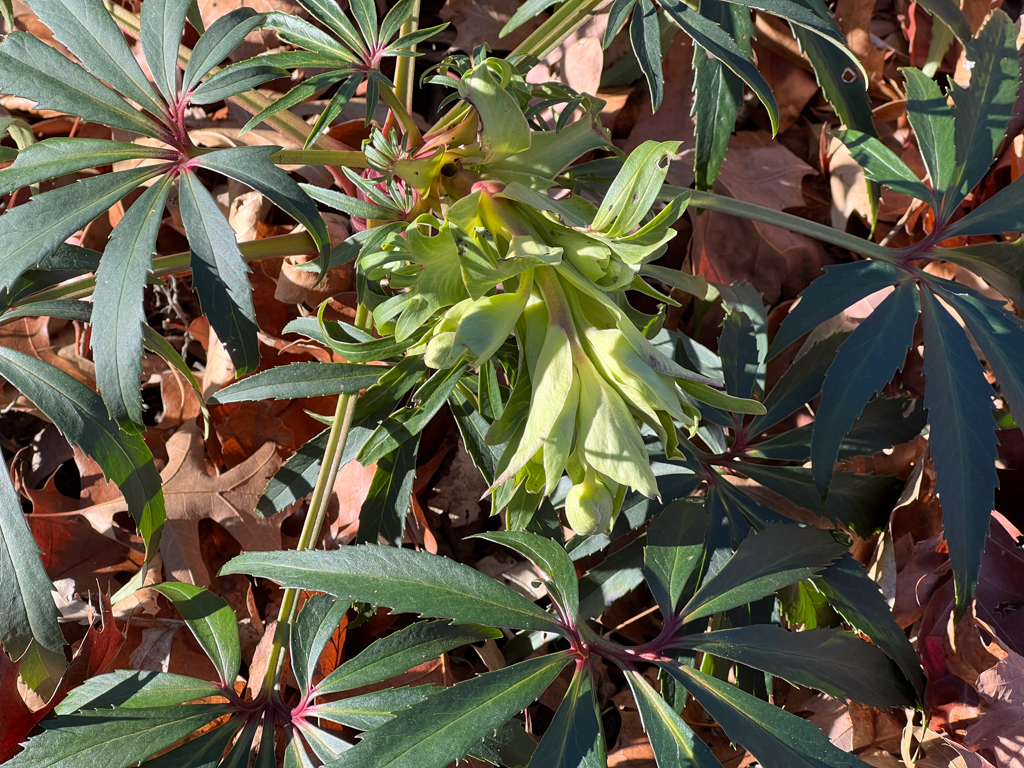
Helleborus foetidus
Lastly I should share the heather which looks like it is going to flower all winter long.

Krarmer’s Rote Heather (Erica x darleyensis)
Garden Blogger’s Bloom Day March 2023

Helleborus x ‘Berry Swirl’
Well it’s two days past Garden Blogger’s Bloom Day but as you can probably imagine Spring is bringing forth not only tons of flowers but springtime chores as well.
As shown above the Hellebores are everywhere and together with the Daffodils they are providing an abundance of flowers.

Hellebore Lost Name
This is one of my favorite Hellebores but I’ve lost the name. It sits upright and shows those lovely crinkly flowers.
Daffodils are one of our favorites for the Spring. We began planting them 45 years ago and here are the results for those first ones.

Daffodils in profusion at the deck

Daffodil bank
Of course it’s hard to not to admire the individual flowers as well.

Daffodils in a cluster
Of course not long from now we will see many members of the Rhododendron family, but here is an early bloomer.

Korean Rhododendron (R. mucronulatum)
I spend a lot of time looking up the little guys that are poking up in the yard and woods.

Haquetia
The first of the Bloodroot popped up yesterday.

Bloodroot (Sanguinaria canadensis)
I planted a hundred Scilla sibirica in the front lawn last Fall and they are just showing their marvelous blue color.

Scilla sibirica ‘Spring Beauty’
Nearby the Primula vulgaris are continuing to spread into the lawn.

Primula vulgaris
I also love seeing the Hepatica with their colorful flowers.

Hepatica nobilis light pink

Hepatica nobilis pink form
We even have one Hepatica in the woods that seems to have taken hold.

Hepatica acutiloba
Also in the woods we also have a number of Corydalis that are slowly spreading.

Corydalis solida ‘Purple Rain’
To help them spread I put in a hundred of the red ones last Fall.

Corydalis solida ‘Beth Evans’
Another successful spreader is the Ranunculus sometimes called Lesser Celandine

Ranunculus ficaria
In the Alpine bed we have a couple of small plants just coming into flower.

Armeria juniperfolia (Spanish thrift)

Polygala chamaebuxus
And in the greenhouse itself there are number of plants seeking attention.

Peruvian Squill alba

Veldtheimia

Notholirion thomsonianum
But the real stars right now are the Clivia that I’ve taken into the house.

Clivia at the house entryway

Clivia in full bloom
Everyone should have Clivia. So colorful, easy care, and blooming twice a year. What’s not to like?
Garden Blogger’s Bloom Day January 2023
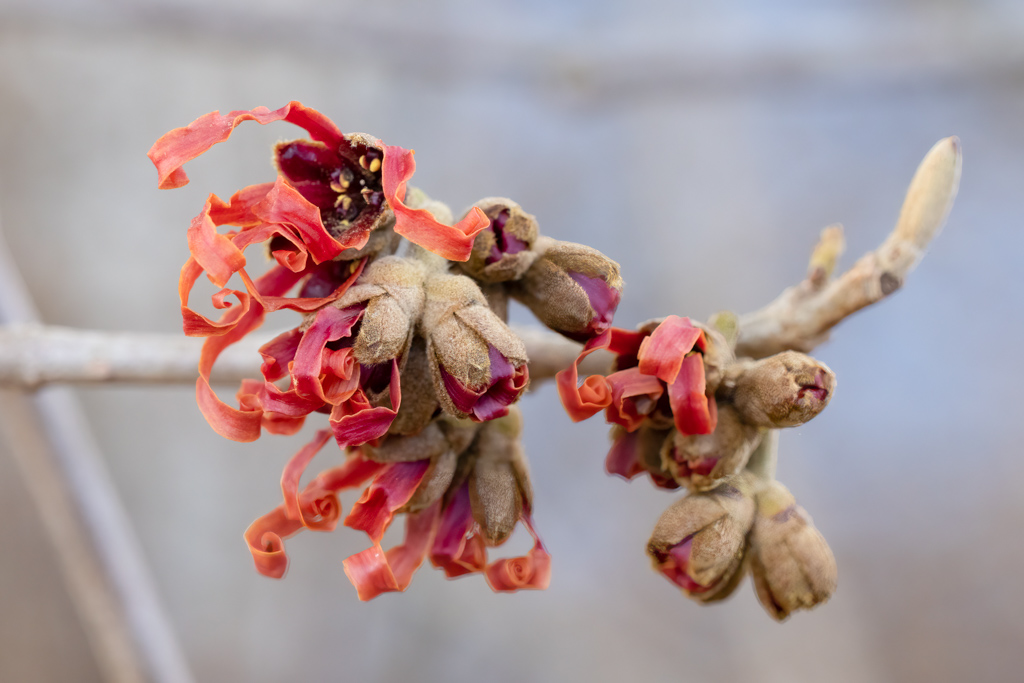
Hamamelis x Intermedia ‘Diane’
Just a quick post for the month with the least flowers on display. Our Garden Blogger’s Bloom Day finds that the winter has been mild but most plants are just fattening up there buds for the months to come. There are a few exceptions. The Witch Hazel shown above is joined by several others on the hillside but none are as spectacular in bloom as ‘Diane.
The snowdrops are popping out. Even a few that have migrated into the lawn.

Galanthus elwesii
And the first of hybrid Hellebores is now in flower (not counting ‘Jacob’ which appeared a month ago)

Helleborus x ‘Winter’s Song’
There are othe plants just on the verge
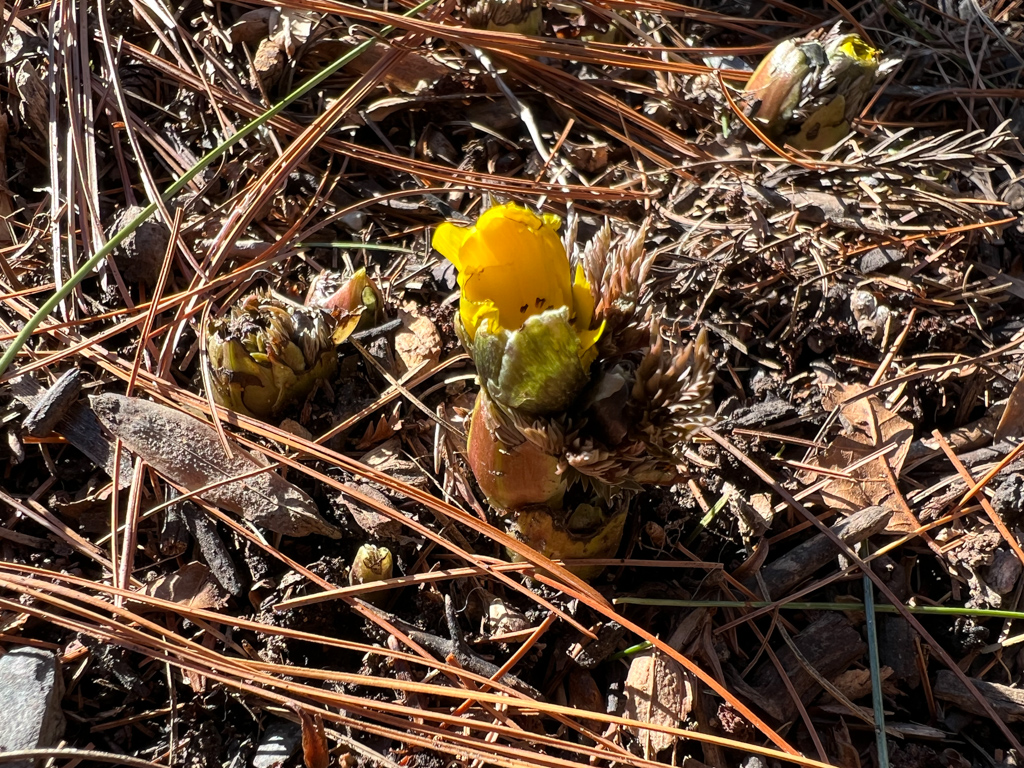
Adonis amurensis ‘Fukujukai’ just opening
And I can see colorful buds on the Peonies.
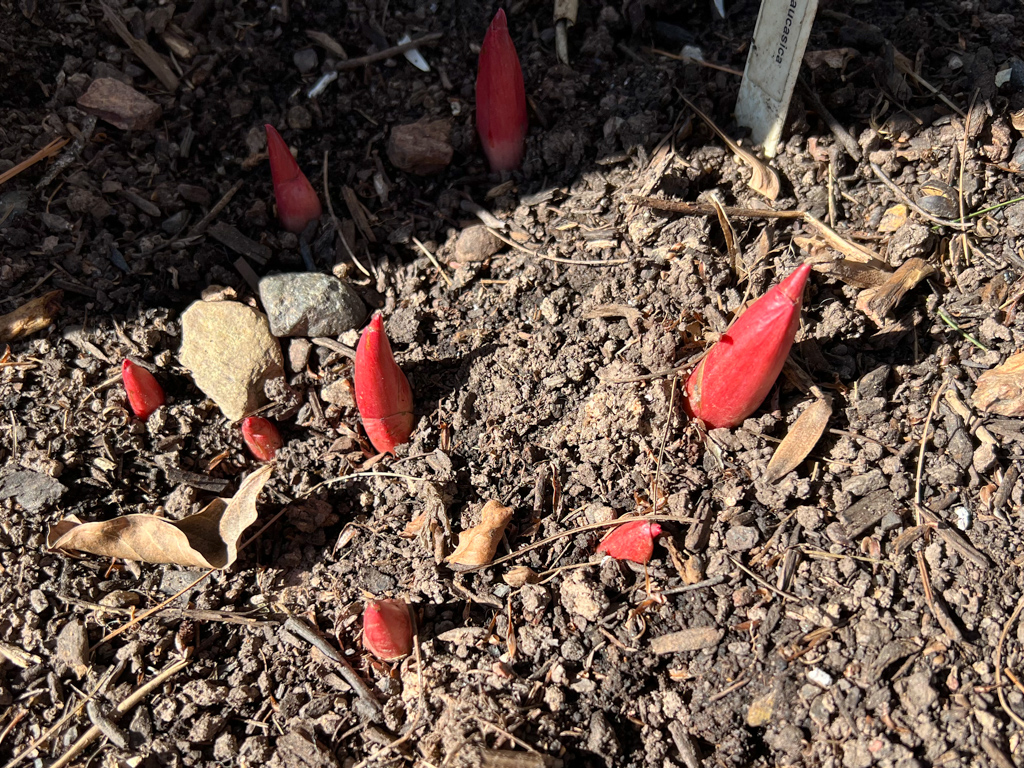
Paeonia caucasica buds
The cyclamen are also noteworthy for the lovely patterns they create as they continue to spread in the yard.

Cyclamen hederifolium leaves
And in the house we have steady stream of flowers from the greenhouse (especially Cyrtanthus) and some new orchids that arrived as Christmas and birthday gifts.

A new orchid for the house
Finally I should point out that we did plant the Christmas tree last week to provide a future landmark in the pasture.
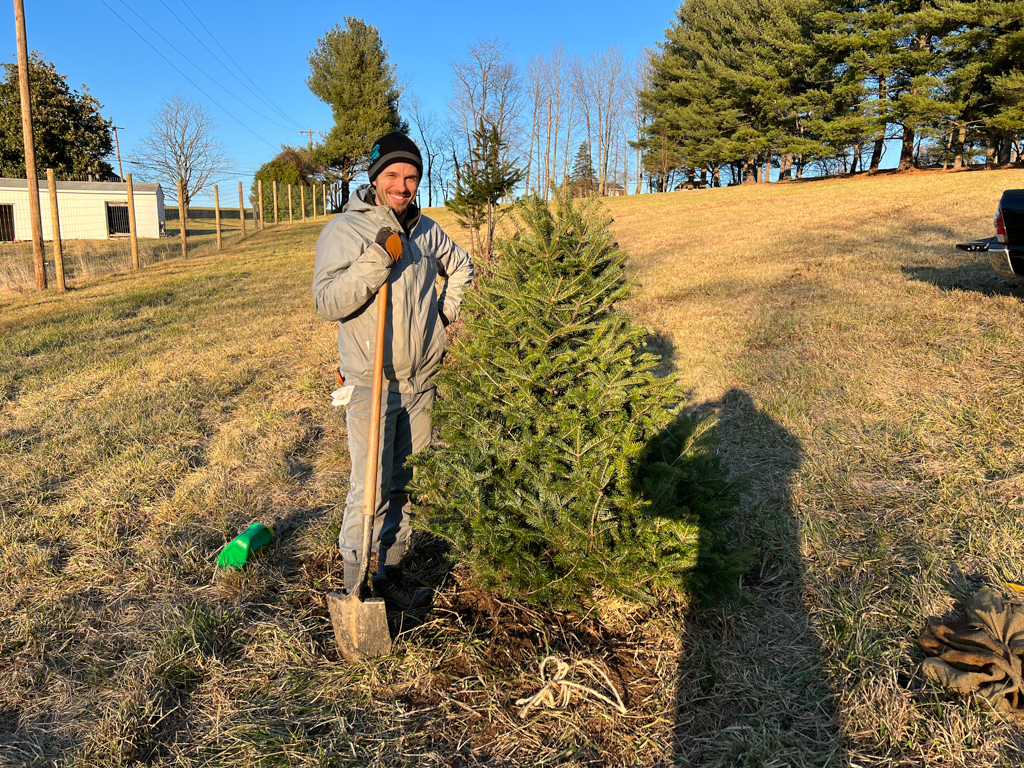
Xmas tree planting for 2023 (Canaan Fir)
This is also the month for planting the seeds obtained from the NARGS seed exchange.
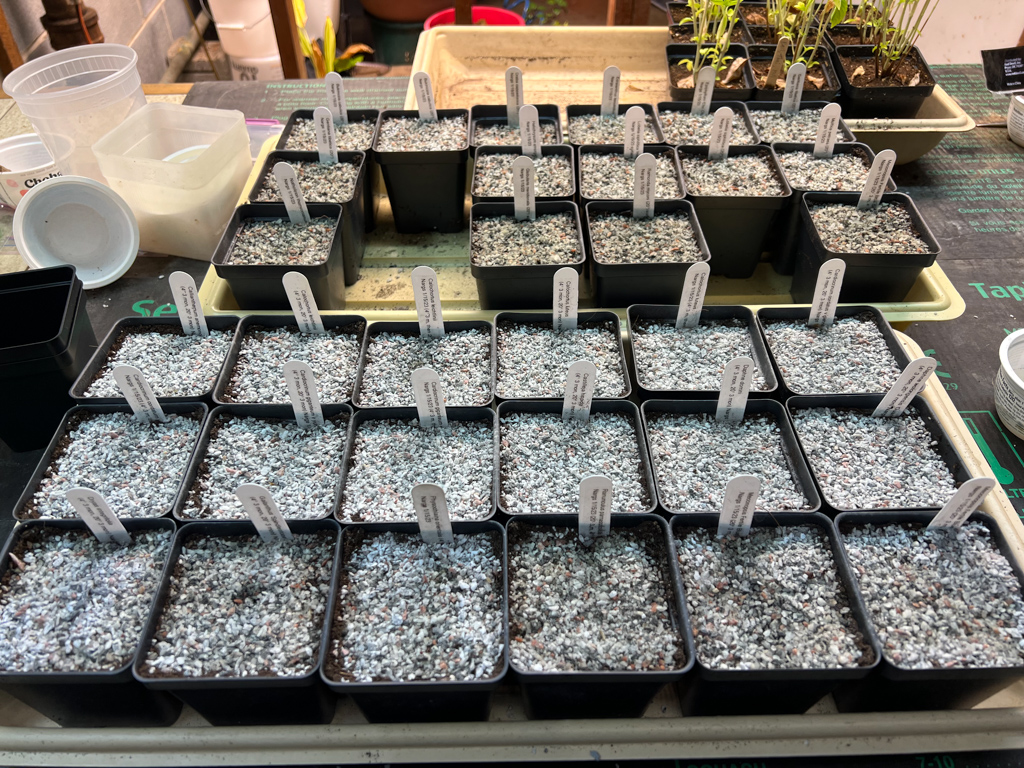
Planting the NARGS seeds
As always there are great expectations.
Garden Blogger’s Bloom Day December 2022

Flowers over the fireplace
I’ll begin this seasonal GBBD post with an image of the Christmas greens and flowers over the fireplace. The Japanese quince has been flowering on and off again all Fall. The the red Camellia sansanqua continues to provide a regular supply of beautiful blooms.
This is what the full plant looks like.

Camellia sasanqua red
and the individual flowers

Camellia sasanqua red
Nearby is another fall Camellia that we brought home from Camellia Forest some years ago.
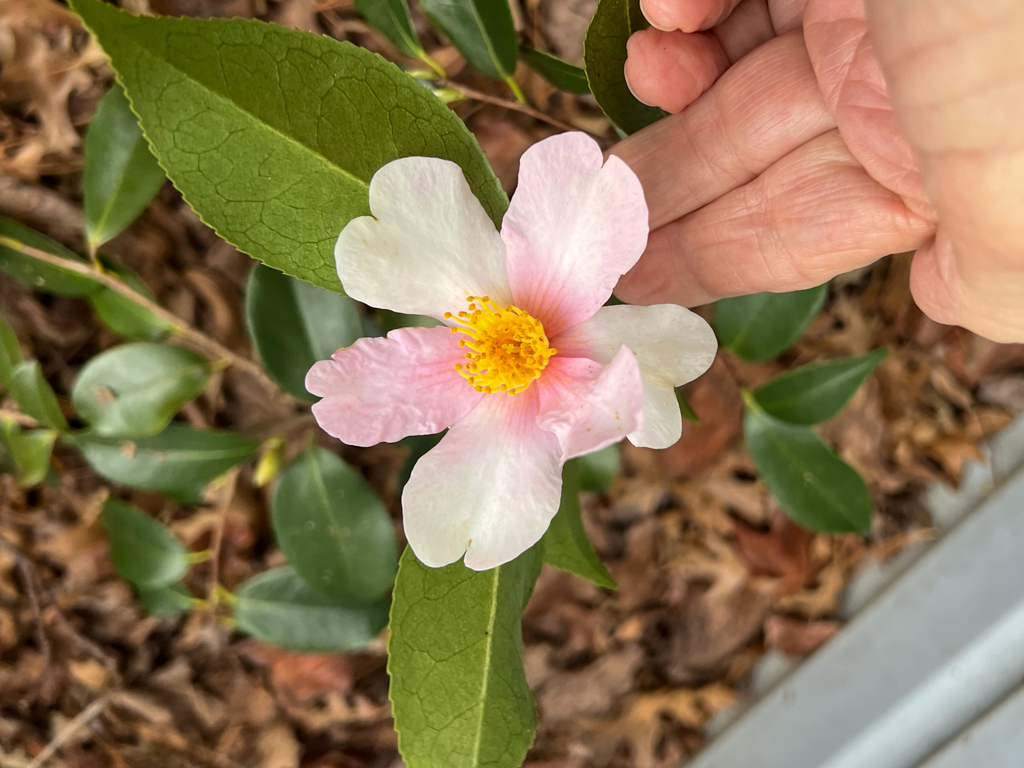
Camellia x ‘Yume’
In the front yard (risking deer damage) is another fall bloomer.

Camellia sasanqua ‘October Magic Orchid’
There are only a few plants in flower besides the Camellias and the Quince. One is the first of the Hellebores (also known as Christmas Rose).

Helleborus niger HGC® ‘Jacob’
I noticed in walking the yard that some of the plants in bud are well worth thinking about as we wait for Springtime. The Edgeworthia is almost better in bud than in flower.

Edgeworthia in bud
And there are several other plants starting to bud up

Cyclamen coum flower buds

First Daffodil buds (Rijnveld’s Early Sensation)

Paeonia caucasica buds
But it is December so one of our seasonal events is to buy a balled and burlapped Evergreen for our Christmas tree. In this case a Canaan Fir seemed to be the most attractive in our size range.
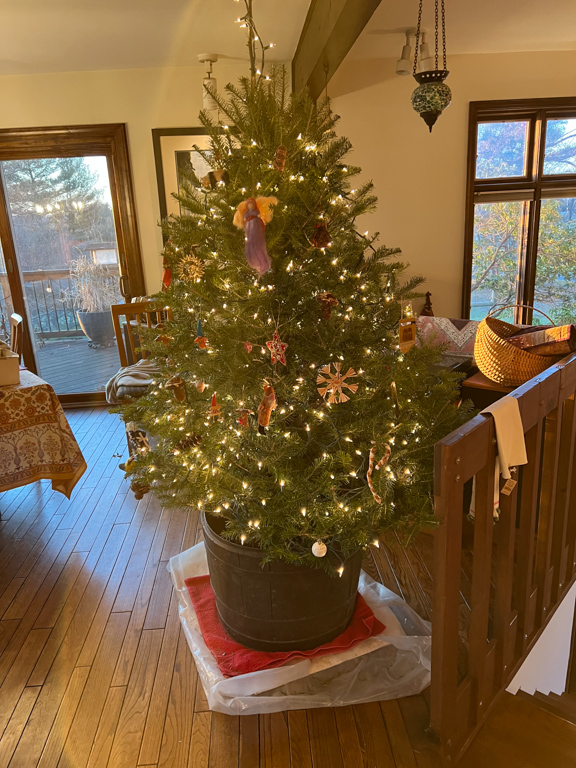
Canaan Fir
After our Christmas elves finished their handiwork it really looks quite splendid

Our Christmas Tree
It will head for the forest in January.
Also inside right now is a pot of Cyrtanthus (like miniature Amaryllis)
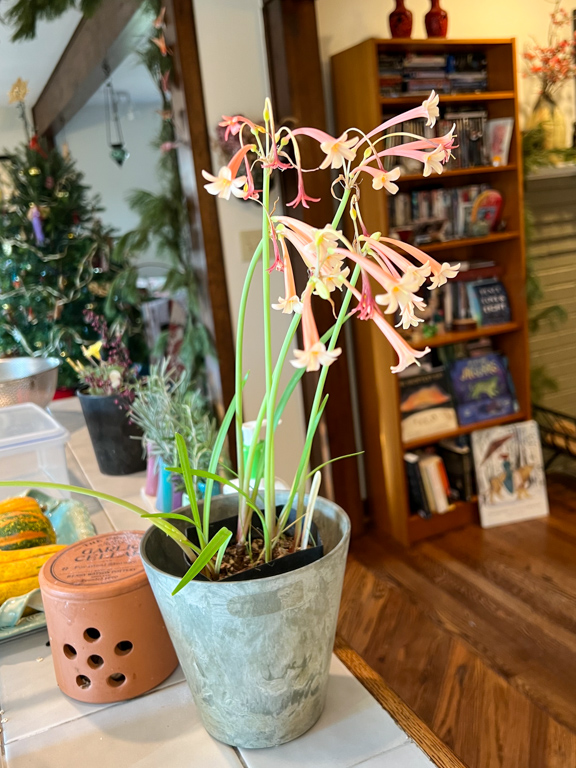
Cyrtanthus mackeni
Besides prepping for Christmas the other thing that goes on this time of year are the various seed exchanges. On December 15th every year the North American Rock Garden Society releases the listing of seeds available through the seed exchange. This year there were 2400 different seed varieties available and the contributions came from all over the world. In my case the seeds I’ve requested came from contributors in the U.S., Canada, England, Scotland, Finland, Poland, Germany, and the Czech Republic. If you have any interest in growing unusual plants from seed I highly recommend exploring the NARGS seed exchange.