
Very Decorative Dahlia
Dahlias seem to be taking center stage for this Garden Blogger’s Bloom Day. I start each year with the intention of posting up the large dahlias in the garden but at first they seem to be supporting themselves just fine. However, by this point in the season I find that they are mostly lying on the ground with their enormous flowers and it’s hard to prop them up without snapping the stems. So perhaps next year I will get them propped up (but probably not…).

Dahlia in the garden
But my favorite dahlia is one stemming from a Welsh hybridizer in the 1920’s. The contrast of the bright red flower with the dark foliage is always noteworthy.

Dahlia ‘Bishop of Llandaff’
Elsewhere we find the roses making a comeback as they always do for a second bloom.

Rose ‘Tess of the d’Urbervilles’
Nearby is a perennial bloomer that was said to be marginal in our area but we find this striking salvia comes back every year and is actually increasing it’s stand.

Salvia guaranitica ‘Black and Blue’
Next to the salvia is a remarkable perennial that dies down to the ground for the winter in Maryland and then comes back vigorously in the springtime. It’s been flowering all summer long and shows no sign of stopping.

Cestrum x ‘Orange Peel’
Also in this garden bed are several instances of Sedum ‘Autumn Joy’. Talk about a low maintenance plant — I hardly notice that its there until it starts flowering.

Sedum ‘Autumn Joy’
Behind this garden is a very large crepe myrtle which is blooming quite happily at the moment

Crepe Myrtle
Out in the pasture is a butterfly bush that is having a lot winged visitors right now.

Buddleia
One of the really nice sights in the yard at the moment is the Limelight hydrangea framed by a pyracantha.

Hydrangea paniculata ‘Limelight’ with Pyracatha ‘Mojave’
I noticed while walking about the yard that the arisaema fruit is almost as showy as a flower.

Arisaema ringens
And as we turn to fall, the greenhouse is already putting out some showy flowers.

Sinninglia sp.

Habranthus magnoi

Nerine masoniorum
and finally the first of the many oxalis that will run through December.

Oxalis bowiei
We feel blessed to have wonderful fall weather in Maryland compared to the horrific fires in the west and torrential rains in the south. Stay safe.
Garden Blogger’s Bloom Day August 2020

Crinum x powellii
A good start for this Garden Blogger’s Bloom Day is the crinum which has been blooming since early july. Although as a plant the crinum is not the most exquisite hortticultural speciment — large strapping leaves and continually expanding its space in the garden — but the individual flowers are lovely.
Another member of the amaryllis family that is popping up right on schedule is what many people call naked ladies.

Lycoris squamigera
We have had a very wet August with many afternoon thunderstorms rolling through.

A wet August leaves everything very lush and green.
In the monument bed we have the last of our lilies. This formosa lily came originally from seed obtained from the Pacific Bulb Society seed exchange.

Lilium fomosanum

Lilium fomosanum
Nearby is a clump of the very pink Allium millenium

Allium ‘Millenium’
A lot of our focus is on the vegetable/flower garden for this season. Every time we visit nowadays the goldfinches erupt from the sunflowers, the hawks make a lot of noise from the surrounding trees, and the butterflies, bees, and hummingbirds are all over the tithonia.

Picking garden is rife with Tithonia

Swallowtail on Tithonia

Sunflowers for the birds

Sunflower (from Autumn Beauty collection)

Sunflowers for the house

Glads brighten up the house

Yet more Glads brighten up the house
The greenhouse still has contributions to the flowerfest. Zephyranthes and Habranthus make a lot of seeds and one needs to pay attention or they will pop up in surrounding pots.

Habranthus tubispathus
The other note for mid-August is finishing the harvest of the garlic.

Northern White Garlic
It was a grand year for the garlic. Of the three varieties we grew, I really like the firm lovely Northern White variety. It’s a hardneck which means that it also contributes scapes in June for the dinner table.
Stay safe and well-distanced.
Garden Blogger’s Bloom Day July 2020

Lilium orienpet hybrid ‘Anastasia’
There are many things blooming at this time of year, but none more assertively demands the attention of your senses than the large oriental lilies. There are other flowers for Garden Blogger’s Bloom day, but i’m going to focus on the lilies.
First and foremost is Anastasia which is so tall and has so many flowers that it is a major task to keep it upright each year. This year we were late so the flowers are bound together in a way that makes them hard to pick. Nonetheless Beth managed to put some on the fireplace.

Lilium orienpet hybrid ‘Anastasia’

Anastasia on fireplace
The last carryover from some of the species lilies was this very special hybrid from lilium henryi.

Lilium henryi hybrid ‘Madame Butterfly’
But most of the focus is on the orientals right now.

Oriental lily ‘Time Out’

Lilium oriental ‘Casablanca’

Lily oriental white/yellow
This last one sits next to Lilium ‘Casablanca’ but is clearly not the same. It’s twins are in other parts of the same bed, but in the center not way over to the edge where this one’s 6 foot tall flower is way out of size. Is this ‘Time Out’? If so my other ‘Time Out’ is quite different with the yellow suffused, not in a stripe. I’ll have to buy more lilies to sort out the difference…
Another instance of a lily not being where I put it is this Scheherezade.

Lilium orienpet hybrid ‘Scheherazade’
It sits across the garden pathway from where the main clump of scheherazade was located. I say was, because this spring the gardener, in a fit of unusual weeding activity broke the stem off the main clump of the Lilium ‘Scheherazade’.
Back in the house again the Stargazer lilies got removed before I could photograph them outside.

Stargazer lilies on mantel
Now there are other flowers in the garden. In particular I would point out the Hydrangea ‘Blue Billow’ not merely because it has never bloomed blue for us, but because it really contributes to the monument bed at this time of the year.

Hydrangea serrata ‘Blue Billow’
There are several spots where the crocosmia are blooming. What a marvelously reliable flower. Kind of like a compact glad that you never have to care for.

Crocosmia ‘Lucifer’
The greenhouse has two zephyranthes cultivars that I particularly like.

Zephyranthes miradorensis

Zephyranthes katherinae rubra
And there are sunflowers that get collected along with annuals from the vegetable garden.

Sunflower collection
Finally I should note that we’ve had a bumper crop of garlic, this first 1/3 of which is now drying out in the garage.

First third of the garlic harvest drying in garage
Garden Blogger’s Bloom Day June 2020

Asiatic Lily ‘Netty’s Pride’
Well there are many flowers blooming for this Garden Blogger’s Bloom Day, but the lilies have captured my attention. These are just the first of the lilies coming down the pike but they capture the eye when you walk about the yard. Besides ‘Netty’s Pride’, another contender for attention is this additional Asiatic hybrid.

Asiatic Lily ‘Forever Susan’
In Beth’s herb bed we have a brilliant yellow whose name has long since passed.

Yellow Asiatic Lily in the Herb bed
Then there also the Martagon lilies with their clustered flowers.

Martagon Lily ‘Arabian Knight’

Martagon Lily ‘Claude Shride’
This last one is a striking red. So much so even in the catalog that I have already ordered more for planting this fall even before I saw this one in bloom. We are beginning to attribute such actions to covid-brain around here…
A lily-wannabe that is pretty in its own right is the Alstromeria ‘Sweet Laura’.

Alstromeria ‘Sweet Laura’
Among the other highlights are two gentians with lovely blue flowers

Gentiana dahurica

Gentiana septemfida (Summer Gentian)
And then there is this Asclepias cultivar with stunning clusters of bright yellow flowers.

Asclepias tuberosa ‘Hello Yellow’
Nearby is Hypericum having one of its most floriferous years ever.

St. John’s Wort (Hypericum calycinum)
In many places we have triteleia showing up from plantings that go back many years.

Triteleia laxa ‘Queen fabiola’
And for a spot of orange we added a little calceolaria this year from Sequim Rare Plants out in Washington State. I’m sure it’s not hardy here, but worth the experiment.

Calceolaria integrifolia ‘Kentish Hero’
A delightful surprise was to see the pointy little head of the arisaema candidissimum finally show up.

Arisaema candidissimum emerging
Every year I am at the point of giving up on this plant given that many other arisaemas have long since put up there leaves. And then lo and behold, up it comes. And it’s relative in lateness arisaema fargesii arose the next day. Both are stunning arisaemas and well worth the wait.
Of course it’s important to add that around here fruit and vegetables are dominating the gardening scene. We’ve been picking strawberries for three weeks and now the raspberries and blueberries are bursting forth.

Raspberries coming ripe
We also have cherries from the wild trees in the forest.

Wild Cherries in our woods
We figure these are seedling planted by the birds from our original orchard trees (and they are now 30-40 ft tall). I picked some from the best tree today.

Best Wild Cherry Tree
Garden Blogger’s Bloom Day May 2020
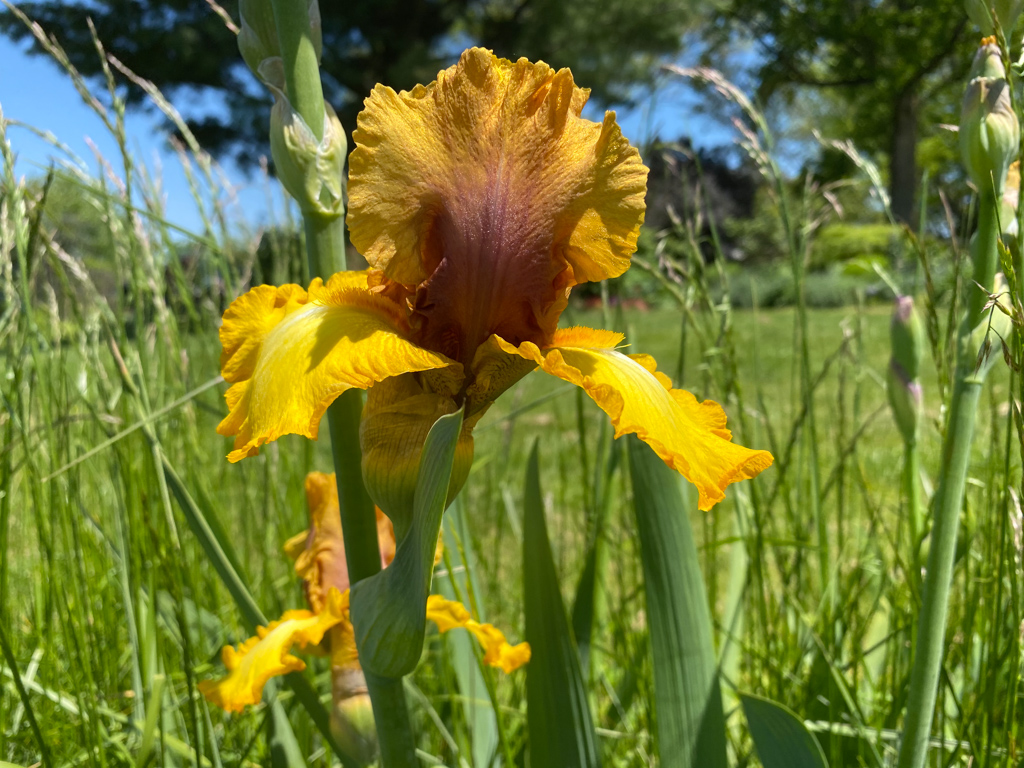
First Bearded Iris of the season
Well here we are in mid-May for Garden Blogger’s Bloom Day in what will be a memorable year for everyone. Gardening supplies are selling out everywhere as people to turn to something they can do at home. At the same time the season has numerous variable weather days ranging from a very early springtime to an actual freeze on May 9th, something I’ve never seen here before.

Ice off of tarp
We covered the raised bed with tarps and when it rained overnight we found sheets of ice on the tarps in the morning. Oddly enough not a single plant was harmed in the process.
There are so many flowers everywhere it is hard to know where to start. The front circle bed abounds with allium that have been spreading all around the garden in between penstemon and centaurea.

Front bed with alliums

Centaurea montana
Also in the front yard we have a self-expanding garden of wood poppies.

Wood poppy (Stylophorum diphyllum)
And near by are their white-colored friends.

Snow Poppy (Eomecom chionantha)
Both are willing to spread everywhere but I try to limit them to the front yard where the deer will occasionally browse.
In the back yard the tree peonies have been magnificent.

White Tree Peony

White Tree Peony
Even one of the species peonies is still blooming.

Paonia obovata
We are beginning to see the first of the Itoh and herbaceous peonies.

Peony ‘Scarlet O’Hara’
In addition to the bearded Iris at the beginning of this post there is the regular blooming of the Japanese Roof Iris and a delightful new small yellow Pacific Coast Hybrid that I got this year from Sequim Rare Plants.

Japanese Roof Iris (Iris tectorum)

PCH Iris ‘Mandalay Bay’
The Rhododendrons are making their annual appearance.

Exbury hybrid Azalea ‘Gibraltar’

Rhododendron ‘Viscosepala’
This last one is a particular favorite. The glorious scent wafts onto the deck all day long. It has a wonderful history going back to the mid-1800’s (see this detailed write-up from the American Rhododendron Society.
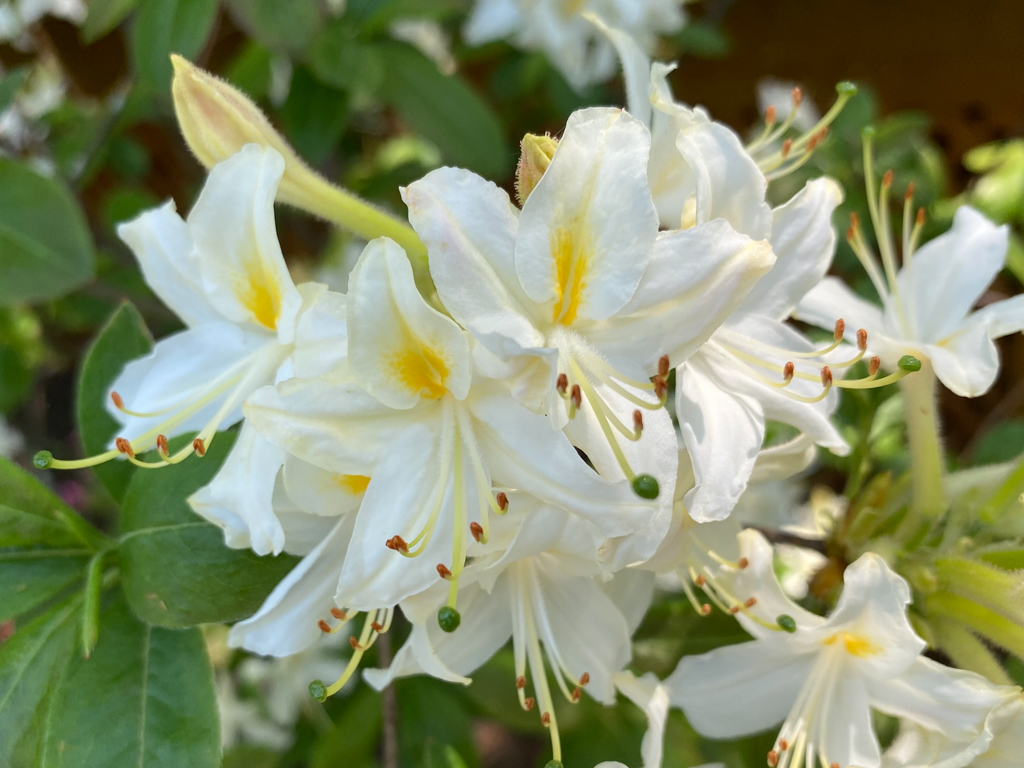
Rhododendron ‘Viscosepala’
This is also the time of year when the various podophyllums are putting out their flowers.

Podophyllum pleianthum
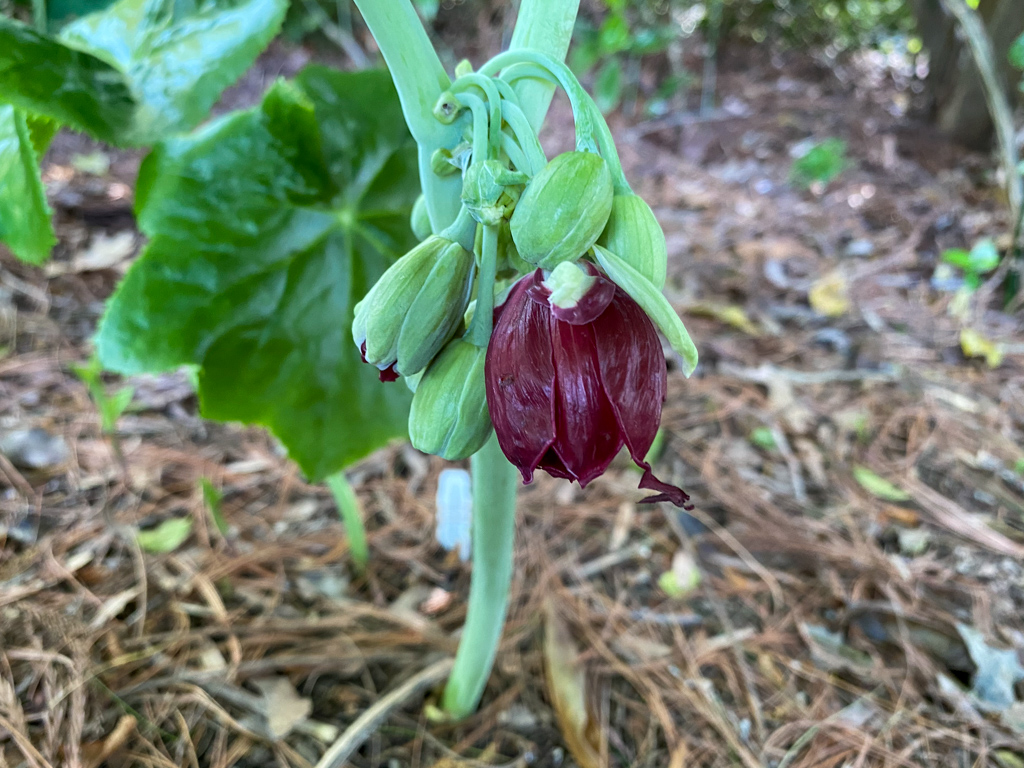
Podophyllum pleianthum flower

Podophyllum delavayi
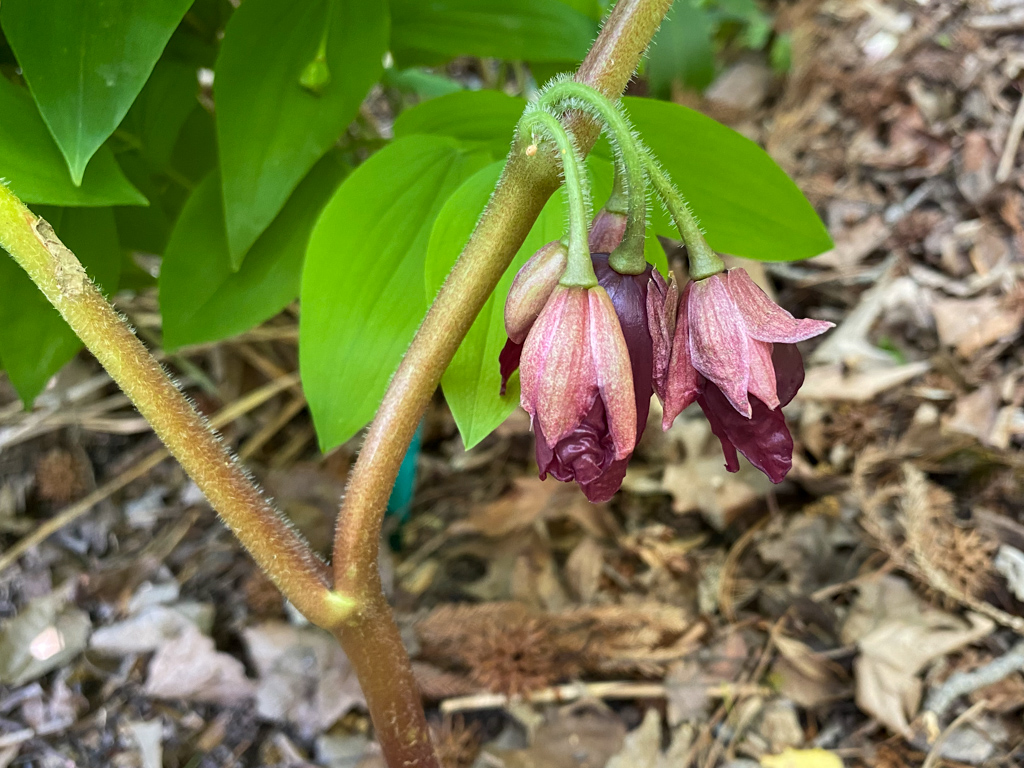
Podophyllum delavayi flower
Then there are various treasures to be found around the yard. These are things I would be sure to point out if we touring together.

Glaucidium palmatum

Calochortus splendens ‘Cupido’

Iris gracilipes

Scilla peruviana
Normally this Scilla is very iffy for us outside but we had such a mild winter it has come out flowering as if were at home in the mediterranean.

Allium nevskianum

Disporum cantoniense ‘Night Heron’
Looking back through the monument bed we see a fully flowering Delaware Valley White

Path in monument garden
and a special aquilegia

Aquilegia buergeriana
Ending back at the Alpine bed we see a very robust flowering of one of the clumps of dianthus

Alpine bed, south side

Dianthus petraeus subsp. petraeus

Dianthus petraeus subsp. petraeus
Finally I will close with a new Edraianthus in a trough at the end of the greenhouse.

Edraianthus graminifolius
Stay healthy and garden well…
Garden Blogger’s Bloom Day April 2020

Paonia macrophylla (?)
It is a very flower-filled time for the GBBD post. Like everyone, we have flowers blooming everywhere and part of my dilemma is always where to focus my time and attention. The species peony shown above led me down an internet road trying to untangle the details of peonies with glabrous styles, purple anthers, and smooth undersides of leaves. On top of that it was just a lovely little peony that I cannot recall acquiring.
There are many other peonies, either flowering or about to flower. I have to admit that I am partial to the species peonies.

Paonia daurica

Paeonia ostii
Nearby the Iris japonica are taking over their region of the garden.

Iris japonica ‘Eco Easter’

Iris japonica ‘Wuhan Angel’
These are definitely spreaders so you want to choose their location with care.
Similarly I’ve noticed how some of the anemones and primroses are happy to spread each year.

Primula sieboldii ‘Chubby One’
Thinking of spreaders, I have tried to move the Cascadian Wallflower from parts of the garden each year and it always finds a new place to make an appearance. But it’s so lovely it’s hard to not just appreciate it.

Erysimum arenicola (?)
In addition an orange flowered wallflower reappeared from a wildflower mix that went in last year.

Wallflower as perennial

Common but beautiful orange wallflower (Erysimum)
The yard as a whole is blessed by the things which happen in the mid-Atlantic April, like azaleas, viburnums, dogwood, and flowering fruit trees.

Back bed springtime

Coral Bells Azalea under Viburnum carcephalum (Fragrant Snowball)
While out in the orchard, things are in extravagant bloom this year.

Granny Smith Apples in bloom

Flowers galore on Spitzenburg apple
The Spitzenburg is one of the finest apples you will ever taste, but when you look at the trunk of this little guy you have to be grateful that it is producing any apples at all.

Trunk of Spitzenburg
Hidden around the yard are still some smaller gems that i look forward to each year.

Hylomecon japonicum

Anomonella thalictrum single pink

Trillium pusillum ‘Roadrunner’

Arisaema ringens
And when we go back to the troughs, the first Gentiana is showing up.

Gentiana acaulis
The alpine beds themselves are both chock full of interesting things like daphnes, stonecress, iris, poppies and the like.

Alpine bed north side

Alpine bed south side
Particularly noteworthy is a little Lewisia returning to claim its space.

Lewisia longipetala ‘Little Raspberry’
and an Androsace which is always welcome.

Androsace sarmentosa ‘Rock Jasmine’
As well as the always striking Bird’s Foot Violet.

Viola pedata
In the greenhouse itself are still things which worth sharing or bringing into the house. The Ferrarias have been blooming since February.

Ferraria ferrariola
Other South Africans include two Ixias, tritonias, and Ornithogalums.

Ixia dubia (?)
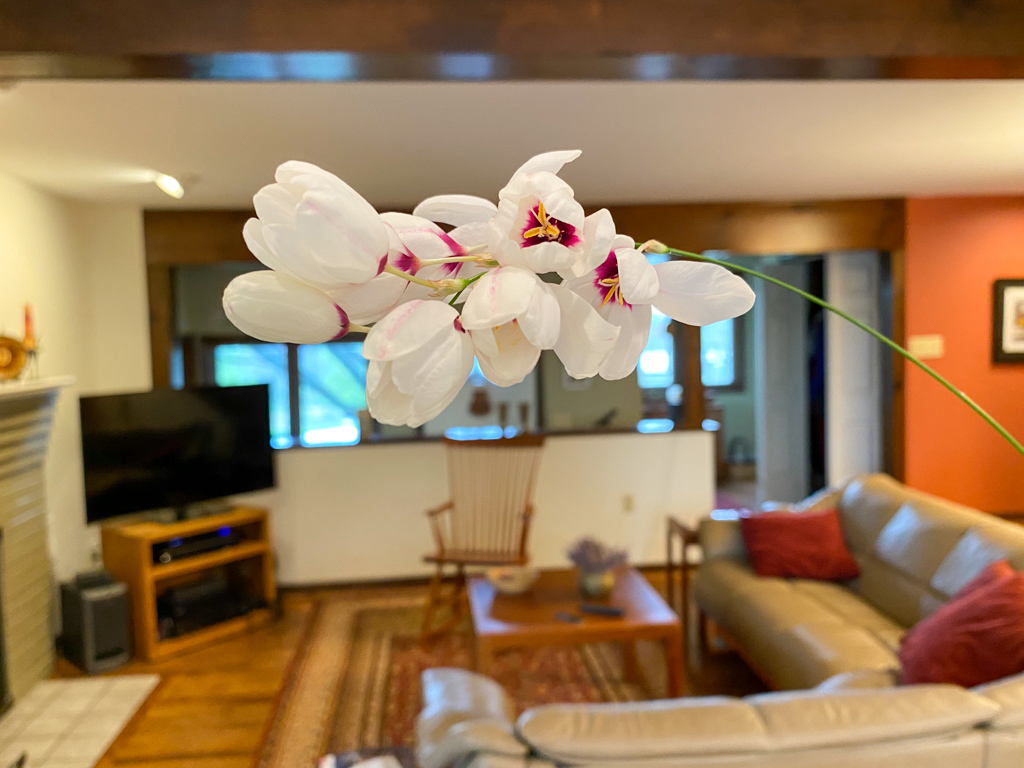
Ixia hybrid on a 30″ stem

Tritonia crocata ‘Princess Beatrix’

Ornithogalum dubium
And, of course, we continue to harvest daffodils from our years of planting.

Arguros and other daffodils
Hoping this post finds the reader healthy and able to enjoy the spring.
Catching up with Spring

Paeonia caucasica
Spring has been rapidly moving onward in the mid-Atlantic. Bringing us, for one thing, the first flowering of a lovely peony above that we acquired from John Lonsdale two years ago.
We like the rest of society have been dutifully staying at home and, in our case, appreciating all the horticultural bounty that nature has to offer. This year many of the plants are well in advance of the norm. Although our nominal last frost date is 2-3 weeks from now the flowering fruit trees (even apples) are already in bloom. Especially bountiful are the blossoms on the Asian Pear.

20th Century Asian Pear (Nijisseiki)

20th Century Asian Pear blossoms
Even the Kwanzan Cherry is fully in flower, fully two weeks ahead of last year.

Kwanzan Cherry
I had the intent to track the progress of the garden a bit closer than usual, but I find myself jumping from one object to another as the plants keep popping up. Erythroniums are especially lovely in the spring, sort of a precursor to the larger lilies to follow. We have a raised bed by the deck that is crammed full of trout lilies (Erythronium americanum). This is what it looked like a week ago.
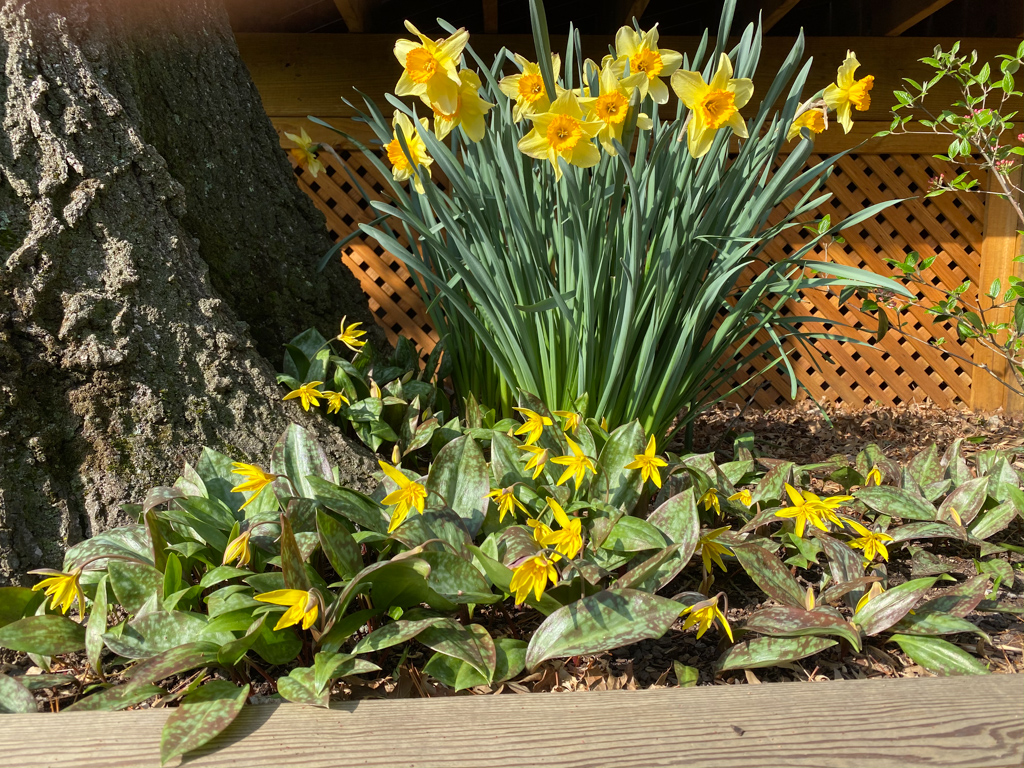
Erythronium americanum
Many years I ago I dug some of these and moved them out to forest in multiple locations. Although the plants have succeeded marvelously in the woods, despite deer and other animals, they do not flower. They spread like mad but they seem to have no interest in flowering. So last year I thought I would inspire them by planting in their midst some horticultural cultivars which have always flowered in the yard (Erythronium ‘Pagoda’). And, indeed, they shot up lovely looking buds which the deer promptly chopped off. Perhaps the E. americanum are simply wiser than me and know that it would be foolish to flower in the forest.
In any case we still have Erythronium to enjoy in the yard.

Erythronium ‘Pagoda’

Erythronium revolutum ‘White Beauty’
Another spectacular genus to enjoy right now are the Epimediums. Beth was gifted with two Epimediums years ago that established large and lovely clumps at the back fence. Not only are the flowers lovely, but the leaves are beautiful in the own right.

Epimedium x rubrum ‘Sweetheart

Epimedium x rubrum ‘Sweetheart’ flowers

Epimedium grandiflorum ‘Lilac Seedling’

Epimedium grandiflorum ‘Lilac Seedling’ flowers
Other Epimediums are well established in other parts of our garden.

Epimedium ‘Pretty in Pink’

Queen Esta Epimedium
Some more traditional parts of the garden probably include this very hardy and early azalea.

Hardy pink Azalea
A spectacular little primrose hybrid.

Magnificent little primula
Multiple trilliums such as the T. grandiflorum

Trillium grandiflorum
Daphne at the front fence

Daphne x transatalantica
And a new japanese quince that I received as a father’s day gift last year.

Chaemoneles speciosa ‘Double-take Scarlet’
But gardens are not made with flowers alone. There are some special green things on their way right now. The little Pteridophyllum has the glossiest green, fern-like foliage at the start of the year.

Pteridophyllum racemosum
Peltoboykinia comes from the high mountains of Japan but seems to be happy here in Maryland.

Peltoboykinia watanabei
Multiple variants to may-apples are on their way.

Podophyllum delavayi
And the first of the Arisaemas is on its way.

Arisaema ringens
While i’m in the yard, I still need to mention the star flowers that have been a real pleasure this year. This little Ipheion has been flowering for weeks now.

Ipheion uniflorum ‘Tessa’
As we go back to the Alpine bed there are a lot of flowers calling for attention

Alpine bed, south side
Two that always stand out are the Pulsatilla and the Armeria.

Pulsatilla campanella

Armeria maritima ‘Victor Reiter’
And at the greenhouse entrance is a trough with a delightful little Androsace that has been a regular participant in our springtimes.

Androsace barbulata
But before I leave off posting for today, let’s take a walk to the forest, through the garden gate and past the very large wild cherry trees.

Wild Cherries
Our trail leads us past many clumps of daffodils that have been planted over the years, past scilla, toothwort, hepatica, anemone, muscari and bluebells

Mertensia virginica
To a very special clump of daffodils with haunting green eyes.

Narcissus ‘Arguros’
Arguros is the Greek word for silver and seems appropriate for this treasure.
May this posting find you healthy and able to enjoy the world around you.
Eranthis and the Daily Walkabout

Eranthis hyemalis
This is a wonderful time of year to watch the Winter Aconite (Eranthis hyemalis) emerge from their slumber. They spread every year — into the grass and other parts of the garden. But it’s a nice kind of spreading. Hardly any other plants are doing anything at this time of year and in six weeks from now they will have disappeared till next year. There are some other color forms of the winter aconite, either paler yellow or orange shades, but one of my strong desires has been to grow the white species, Eranthis Pinnatifida. I got one flowering a few years ago, but it didn’t stay with us. Nevertheless, the flower is so intriguing that I keep persisting. I ordered one from Japan last fall and got it planted out in December. I noticed on my daily stroll about the garden that It is growing but it looks like no flowers this year.

Eranthis pinnatifida from Japan
At the same time, and almost so small that i nearly missed it, I found a flowering Eranthis pinnatifida in a seeding pot that I had started in 2016 from seeds obtained from the NARGS seed exchange.

Eranthis pinnatifida
Not only was this little jewel growing but there was another little Eranthis in the same pot. So hope spring eternal someone once said.
The seed exchanges are a wonderful introduction to new plants that you will never see in a commercial catalog. My package from the Alpine Garden society arrived just this week.

Seed Exchange package from the AGS
But I have already started many seeds obtained from NARGS, the SRGC, and individual seed vendors.
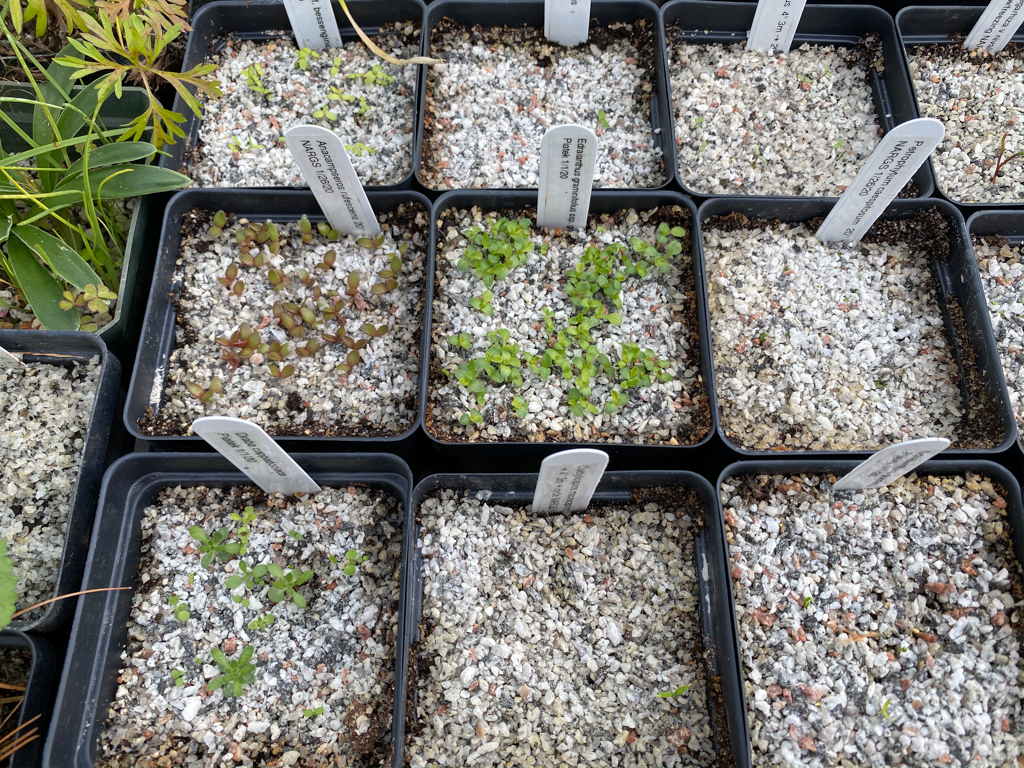
Seed Exchange plantings
Also in the greenhouse is the first of the Ferrarias to bloom this year.

Ferraria crispa
Ferrarias are very easy to grow and easily one of the most unusual flowers you will ever set eyes on. The curls around the edge have a fractal quality to them.
I also just brought the first of many Scilla peruviana into the house to enjoy.

Scilla peruviana
But getting back to the daily walkabout, I would be remiss not to note that many crocus and snowdrops are appearing around the yard.

Crocus tommasinianus
And the first Primula is showing it’s flowers as well.

Primula vulgaris
Like the Winter Aconite, these are happy to spread into the lawn.
A more unusual spotting from the walkabout was to see the first pink color in one of the Saxifrages in a trough.

Saxifraga ‘Valerie Keevil’
This little jewel flowered in April last year.
And I also noticed in the alpine bed that one of the Callianthemums from Japan that I planted in December has a bud on it!

Callianthemum miyabeanum
These plants are really hard to find in the U.S. and my thanks to Yuzawa Engei for the wonderful packing to get it here.